
Friday, July 16, 2010
THR_33 Smile Scan
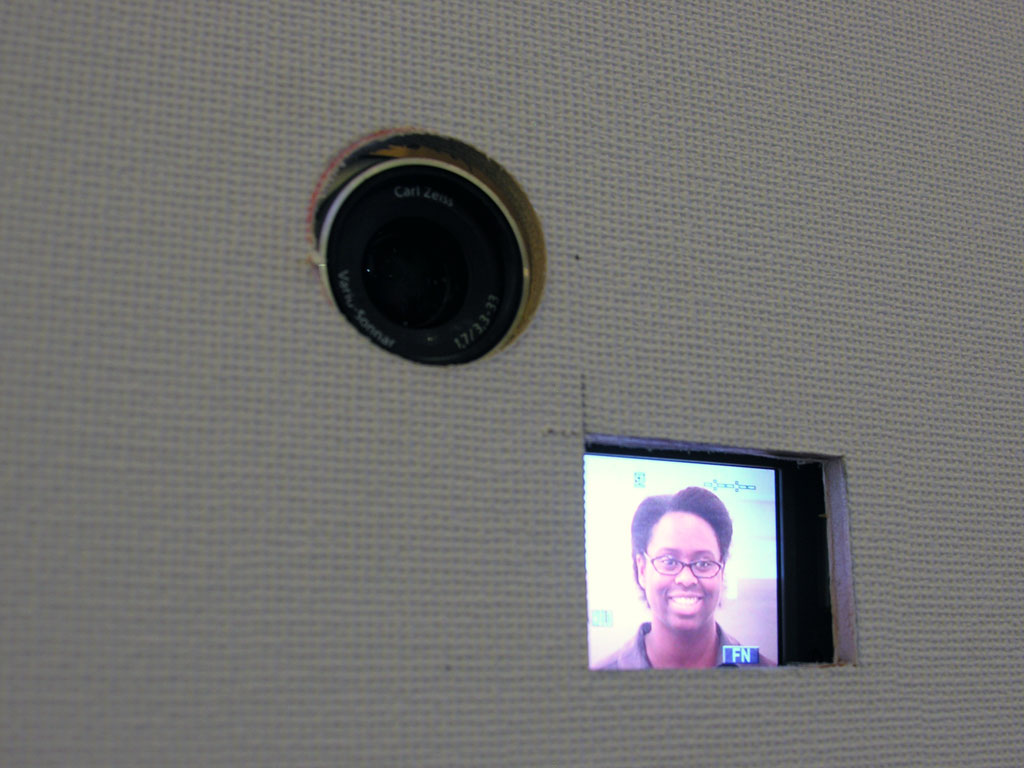
When someone approaches the tea house they are visually scanned by by the OMRON Smile Scan.
"The system measures the degree of a person’s smile from a camera-recorded facial image based on its original criteria using facial key point movements. The resulting data is displayed onscreen with a percentage reading from 0% to 100%."
In THR_33 this percentage controls how much the tea-house "eyes" open - so if they are smiling the "eyes" will allow for a direct line of sight between the visitor and the robots.
When TST_003 (the toaster) "sees" someone with its passive infrared sensor it will initiate its toasting cycle - it stops roaming and both its toasting drawers extend. Also, the inside of the robot illuminates.
When RDO_002 (the radio) "sees" someone with its passive infrared sensor it will play a randomly chosen sound sample from a library of samples of robots from science fiction movies.
When MXR_011 (the mixer) "sees" someone with its proximity sensor it will spin away from them (we figured when it is in regular use it would have to mix in one direction only - so in the tea house it would spin whichever way takes its fancy).

Tuesday, July 13, 2010
THR_33 on Dezeen
THR_33 featured on Dezeen.

"Dezeen was launched at the end of November 2006 and has grown rapidly to become one of the most popular and influential architecture and design blogs on the internet."

"Dezeen was launched at the end of November 2006 and has grown rapidly to become one of the most popular and influential architecture and design blogs on the internet."
Thursday, July 08, 2010


Trouble in Paradise/Medi(t)ation of Survival (Opening)
The 'Trouble in Paradise/Medi(t)ation of Survival' exhibition has opened at the National Museum of Modern Art, Kyoto. The opening was by invite only. Somehow (???) an invitation managed to fall into a photocopier and copies managed to get attached to crates of beer that were left outside the Museum to be taken freely. Rumor has it that by some strange twist of fate someone had been distributing flyers throughout Kyoto that said free beer would be available at the Museum at exactly the same time as the opening...


Light/Sound/Brain - Koichi Mori

Bee’s - Susana Soares

Hug Machine - Temple Grandin

The Blind Climber/Linus’s Walk - Tomoaki Ishihara + Kodai Nakahara


Space Garden - Shiro Matsui + Yukihiro Morimoto + Akihiko Inoue

Genetic Modification Theater - Critical Art Ensemble


Trans-Acting: Double-Axel Rotating Stage/Walking Afloat—A Topological Experiment on Time Space and Memory Formation Based on Studies of Space Travel, Dementia, Gardens, and Developmental Disorders - Satoru Takahashi + Shiro Matsui

The exhibition catalog is in the form of a 'workbook'. Several pages are intentionally blank. Additional materials, cameras, copiers and printers are available in the Museum so that visitors to the exhibition can complete their own catalog with the things they find most interesting.


Light/Sound/Brain - Koichi Mori

Bee’s - Susana Soares

Hug Machine - Temple Grandin

The Blind Climber/Linus’s Walk - Tomoaki Ishihara + Kodai Nakahara


Space Garden - Shiro Matsui + Yukihiro Morimoto + Akihiko Inoue

Genetic Modification Theater - Critical Art Ensemble


- Biomusic: Water/Forest/Life/Sound—A Project Based on Fieldwork in the Lake Biwa Canal, the Garden of Heian Jingu Shrine, and the Kosei-no-Mori Forest - David Dunn

Trans-Acting: Double-Axel Rotating Stage/Walking Afloat—A Topological Experiment on Time Space and Memory Formation Based on Studies of Space Travel, Dementia, Gardens, and Developmental Disorders - Satoru Takahashi + Shiro Matsui

The exhibition catalog is in the form of a 'workbook'. Several pages are intentionally blank. Additional materials, cameras, copiers and printers are available in the Museum so that visitors to the exhibition can complete their own catalog with the things they find most interesting.


Wednesday, July 07, 2010
A few hours of final tweaks...
Trouble in Paradise/Medi(t)ation of Survival at MoMAK gets its first visitors later today. We have a few hours left to fiddle with things and give THR_33 a few last tweaks.


RDO_002 is now happily working after we scoured Kyoto for a replacement power supply and had the Museum electrician hack the one we found.

TST_003 is now toasting again after a brief hiatus when the LEDs went on strike.

MXR_011 is designed to behave erratically and is doing just that.

The view the public never gets to see. The black area on TST_003's platform is what triggers the QTI sensors to make it back up and turn.

Cezanne checking the Smile Scan. It covers quite a wide area and is very responsive. It will find and track up to 2 faces and will open the tea-house "eyes" based on the percentage that those faces are smiling. It scans the passage between THR_33 and Critical Art Ensemble's Genetic Modification Theater. This is also the main route between 2 of the Museum's main gallery spaces.


RDO_002 is now happily working after we scoured Kyoto for a replacement power supply and had the Museum electrician hack the one we found.

TST_003 is now toasting again after a brief hiatus when the LEDs went on strike.

MXR_011 is designed to behave erratically and is doing just that.

The view the public never gets to see. The black area on TST_003's platform is what triggers the QTI sensors to make it back up and turn.

Cezanne checking the Smile Scan. It covers quite a wide area and is very responsive. It will find and track up to 2 faces and will open the tea-house "eyes" based on the percentage that those faces are smiling. It scans the passage between THR_33 and Critical Art Ensemble's Genetic Modification Theater. This is also the main route between 2 of the Museum's main gallery spaces.

Tuesday, July 06, 2010


Monday, July 05, 2010
THR_33 Setup

The robots ready for their big trip.

Packing the robots (very carefully) in the case we got for them. After all that, TSA at Detroit airport partially disassembled our robots, then flung the parts they had taken off inside the shells and badly packed them up again. We didn't know till we got to Kyoto. They undid a bunch of nuts - so the robots shipped with Arduinos and sensors rattling around inside them. They also undid the toast mechanism. So our first morning at the Museum was spent fixing the robots.

Taisuke Murakami made the system that allows the tea-house "eyes" to be driven by the OMRON Smile Scan. Here he is pictured explaining to us how to connect the system.
"Designed for objective and quantitative evaluation of smiles, “Smile Scan” utilizes Omron’s “OKAO Vision” face sensing technology. The technology relies on facial data gathered from over 1 million people, accumulated through over 10 years of study of the human face. The system measures the degree of a person’s smile from a camera-recorded facial image based on its original criteria using facial key point movements. The resulting data is displayed onscreen with a percentage reading from 0% to 100%."
In THR_33 this percentage controls how much the tea-house "eyes" open.

Day 2. Unpacking the tea-house crate. The Museum staff were "amused" by the fact that we used 4 different kinds of screws (Phillips, 2 sizes of Torx and Robertson) and put them in from every possible angle (including from underneath). They are more used to unpacking delicate and valuable objets d'art - MoMAK chief curator Shinji Kohmoto (pictured on the right, arms outstretched) said they could enjoy this because it was "wild".

MoMAK's excellent team go to work on the tea-house structure...

... done.

We have integrated the Smile Scan with the tea-house and had it working - tomorrow we need to get everything in its final place and get the robot platforms in.
Thursday, July 01, 2010
A short note on the 'robots'...
Michael Hohl hit the nail on the head:
"It reminds my of Buckminster Fuller's 'dymaxion car' that could also turn on the spot (though without a tethering cable ;) )"
All 3 robots are hybrids of vehicles and products: TST_003 = Dualit + Airstream; RDO_002 = Bush TR82 + GM Futurliner and as Michael pointed out, MXR_011 = KitchenAid Mixer + Dymaxion Car. We are playing with futurism as a 'retro' phenomenon. The styling and color palette is based on the 1950s RayGun Gothic - or as we like to call it SodaPop Chic!
Other (more subtle) references in the color choice:


MXR_011's fire engine red is simply the color of our actual KitchenAid mixer.
"It reminds my of Buckminster Fuller's 'dymaxion car' that could also turn on the spot (though without a tethering cable ;) )"
All 3 robots are hybrids of vehicles and products: TST_003 = Dualit + Airstream; RDO_002 = Bush TR82 + GM Futurliner and as Michael pointed out, MXR_011 = KitchenAid Mixer + Dymaxion Car. We are playing with futurism as a 'retro' phenomenon. The styling and color palette is based on the 1950s RayGun Gothic - or as we like to call it SodaPop Chic!
Other (more subtle) references in the color choice:

MXR_011's fire engine red is simply the color of our actual KitchenAid mixer.
Subscribe to:
Posts (Atom)


