
Showing posts with label blog. Show all posts
Showing posts with label blog. Show all posts
Thursday, June 19, 2008
Designed Objects v5.
At about 11.00 pm last night I was asked a question about setting up a blog. By 5.30 am Designed Objects had been completely made over (I've got to realize when I am educating people against their will). If you are looking for the stuff that is usually in the sidebar it is now in the footer.

Wednesday, October 17, 2007
»Hidden & Sought« (call)
 Marco Siebertz writes: "...we are a young international non-profit design magazine made by students at the Köln International School of Design www.kisd.de Our next issue is about the invisibility of design - "Hidden and Sought" will be the title. We are looking for interesting projects from that subject."
"Roger questions the existent, criticises the forthcoming, illuminates backgrounds and promotes the design discourse."
http://roger.kisd.de/
Thursday, October 19, 2006
More PBB
There is a review of Perimeters, Boundaries and Borders HERE.
And a posting about the show on Generator.x
Other (sometimes unintentionally funny) links at:
Lancaster Today
BBC Lancashire
Lancaster City Council
And a posting about the show on Generator.x
Other (sometimes unintentionally funny) links at:
Lancaster Today
BBC Lancashire
Lancaster City Council
Friday, October 13, 2006
A fresh coat of paint...
I switched this blog to the new beta platform and took the opportunity to freshen things up. The new version is completely modularised. The tagging ...er, 'label' system is useful - so I went back and applied it to all my previous posts. Then I realised that I essentially republished everything. So, apologies to any subscribers whose feeds just got burned with a slew of old posts. Sorry. No doubt I'll continue to tweak the curtains for a bit.
Thursday, July 13, 2006
Vanity
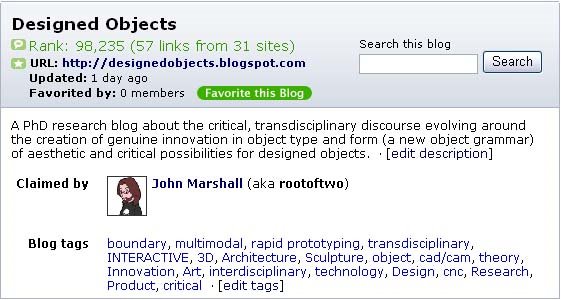 Designed Objects just broke into the top 100,000 of 48.1 million sites currently being tracked on Technorati - you've got to take your thrills where you can get them!
Friday, June 09, 2006
Wiki Maintenance
I have tidied up and added some more information to the designedobjects wiki.
There is amongst other things another (groan) bibliography and a resource page. It also looks prettier, too.
Remember to check out the designedobjects reblog to see the projects that have caught my attention from the blogosphere.
Links are always over there >>> in the sidebar.
There is amongst other things another (groan) bibliography and a resource page. It also looks prettier, too.
Remember to check out the designedobjects reblog to see the projects that have caught my attention from the blogosphere.
Links are always over there >>> in the sidebar.
Thursday, May 18, 2006
Recursive Instruments
 From 3pointd:
"Second Life residents will soon be able to order up physical versions of their avatars, their builds or their favorite Second Life objects in full 3D, and in a variety of materials, thanks to a pair of students at the Art Institute of Chicago. Simon Spartalian (aka Simon Jezebel in SL) and Mike Beradino (a recent graduate of the Art Institute) will launch the service on June 1, offering to mill SL objects up to 9″X 5″X 5″ out of anything from foam to wax to stainless steel. The pair are already documenting their milling efforts at their Recursive Instruments blog."
Thursday, May 11, 2006
Craft Research (blog)
Recently I've been having an interesting exchange with Mike Press . Mike has posted some questions and links at the Craft Research blog:
"Karl Marx was perhaps the original prophet of the Pro-Am economy. In The German Ideology, written between 1845 and 1847, Marx maintained that labour – forced, unspontaneous and waged work – would be superseded by self-activity. He evoked a communist society in which: ‘. . . nobody has one exclusive sphere of activity but each can become accomplished in any branch he wishes . . . to hunt in the morning, fish in the afternoon, rear cattle in the evening, criticize after dinner, just as I have a mind without ever becoming hunter, fisherman, shepherd or critic.’ By the mid-1850s Marx had already modified this utopian vision and instead looked forward to a time when ‘material production leaves every person surplus time for other activities’. The Pro-Am Revolution: how enthusiasts are changing our economy and society is a book by Charles Leadbeater and Paul Miller published by Demos. Available as a download from here, the book describes the rise of "amateurs who work to professional standards", and who are transforming all fields from music through to software, business and astronomy: "The Pro-Ams are knowledgeable, educated, committed and networked, by new technology. The twentieth century was shaped by large hierarchical organisations with professionals at the top. Pro-Ams are creating new, distributed organisational models that will be innovative, adaptive and low-cost." In the passage at the top of this post, the authors are making the point that technological and cultural changes are moving us very close to Marx's ideal of how a communist society would actually work. A more recent article in Fortune suggests the significance of the DIY economy. DIY is thus a mash-up of the post-industrial enterprise economy and good old unreconstructed communism. Today I received an email from the ever-perceptive John Marshall who was trying to link together some of the issues I've been raising in this blog with issues that he too has been exploring. Links he provided led me, somewhat accidently, to the Leadbeater book and the Pro-Am thesis, which strikes me as one way of framing some of this stuff. To quote from John:
I was reading your posts at www.craftresearch.blogspot.com when I made a mental connection to something I was reading at Anne Galloway’s blog:
“In the past I would have considered these things amongst the ill effects of capitalism, but now I think it's a bit more complicated than that. After all, some of this labour is actually being done for free. Out of love even, like with Flickr or any number of mod communities. The DIY ethic, in fact, is based on the power of creative re-use and re-appropriation. But these terms are now being tossed around in software and hardware development like organisations and companies only care about democratic participation, and not profitability. Jean Burgess knows much more about mass amateurisation and vernacular creativity than I do…”
There are some interesting posts at Jean Burgess’s blog creativity/machine on vernacular creativity (see under categories in her sidebar). I think that is a great academic term to describe this type of activity. [edit: concise definition of VC here ] I agree with John that Vernacular Creativity is a useful term to describe these emergent activities which focus around craft and making. The digital culture that manifests VC appears to be growing rapidly: there is HobbyPrincess and her Craft Manifesto, there's the Make blog, from which is arising Craft Magazine. Then we have Readymademag, and the making things blog. Taking an interesting and explicit political position is Craftism. I am trying to document as many of these as I come across on my del.icio.us page. I have thrown all of this down, not to make a point, but rather to pose some questions: What implications does all this have for "fine craft", and how does it change the culture of consuming such craft? How should we regard the rise of vernacular creativity? How should we curate and critically comment on the digitally connected vernacular crafts? What are the political implications of this new culture?"
*** My own feeling is that the conjunction of technology and culture has shaped new creative opportunities which break with previous domain-specific models of practice. As these technologies become increasingly affordable and prevalent and computing enters its pervasive, networked phase the expectations we have of the objects we surround ourselves with are being transformed. Specifically, the outputs of the current dominant economic and corporate drivers might to some extent, be replaced by artefacts and designed objects whose function is to provide alternate or parallel values to established design discourses. For example, these new objects may be designed to purposely subvert these established models, whereby the end-user is invited to reflect on their cultural role and/or the means of their creation. This has the result that new forms of consumption for audiences, users and/or co-creators of the objects produced might feasibly be developed (e.g. design for exhibition and/or publication in the manner of conventional fine art objects, design to order, mass-customisation, etc.). In my research I am working with a core group of texts that underpin my current thinking on this: CHAPMAN, J., 2005. Emotionally durable design: objects, experiences and empathy. London: Earthscan Publications Ltd. GERSHENFELD, N., 2005. Fab: the coming revolution on your desktop - from personal computers to personal fabrication. New York: Basic Books. STERLING, B., 2005. Shaping things. Cambridge, Massachusetts: The MIT Press. THACKARA, J., 2005. In the bubble: designing in a complex world. Cambridge, Massachusetts: The MIT Press. VON HIPPEL, E., 2005. Democratising innovation. Cambridge, Massachusetts: The MIT Press – particularly in light of the fact that IBM has agreed to have its patents vetted by the public in the community patent peer review project "Peer to Patent." I have a hunch that the current upsurge in vernacular creativity can be seen as the reintegration of practices that have been left out on a limb (in terms of value) since the Renaissance. I think what we are seeing is a new form of “postindustrial design” (Peter Lunenfeld - Professor in the Graduate Media Design Program at Art Center College of Design in his 'endtroduction' to Shaping Things.) Gershenfeld has discussed this in his book:
“The trivium and the quadrivium together make up the seven "liberal arts." Both of these words warrant comment. "Liberal" in this sense is not the opposite of "conservative"; it referred to the liberation that the study of these subjects was thought to bring. And "art" did not mean just creative expression; it meant much more broadly the mastery that was developed over each of these domains. Liberal arts originally has this rather rousing meaning as a mastery over the means for personal liberation. They're now associated with academic study that is remote from applications, but they emerged in the Renaissance as a humanist pathway to power… Unfortunately, the ability to make things as well as ideas didn't make the cut; that was relegated to the artes illiberales, the "illiberal arts," that one pursued for mere economic gain. With art separated from artisans, the remaining fabrication skills were considered just mechanical production. This artificial division - led to the invention of unskilled labor in the Industrial Revolution”. pp 34.
My research is concerned with designed objects created from the application of industrial means, methods and processes (out with the strictly commercial environment) and cultural contexts which offer possibilities for new forms of convergent practice. I also find myself having to keep using the words "mere" and "just" to make distinctions between objects that experience slippage from one domain to another. Gershenfeld has been implementing Fab Labs (Fabrication Laboratories) http://fab.cba.mit.edu/ These include $25,000 worth of kit: a laser cutter, a sign cutter, a CNC milling machine and a suite of open source software and programmes written by researchers at the Center for Bits and Atoms (CBA) at the Massachusetts Institute of Technology. This Fab Lab programme "brings fabrication capabilities to under-served communities that have been beyond the reach of conventional technology development and deployment. Fab Labs have been opened in rural India, northern Norway, Ghana, Boston and Costa Rica". In his book, Gershenfeld writes about reflecting on the Fab Lab they set up on a farm owned by S.S. Kalbag in rural India:
“…I had returned to the United States and was visiting the research labs of an integrated circuit manufacturer that was developing devices based on work at MIT. Those chips were designed by teams of engineers and produced in billion-dollar chip fabs. We were discussing new applications for the first version of the chips, and measurement strategies to use in the next generation. When I suggested that we try these ideas out, the reaction was the same as in Delhi: they looked at me blankly. There was no way for an individual with an idea there to invent something alone; the corporate development process demanded the skills of groups of specialized engineers, using expensive facilities distributed over multiple sites. When I jokingly suggested that we go to Kalbag’s farm, the silence in the room suggested that the joke was very serious. The possibility that a rural Indian village had technical capabilities missing in a facility at the apex of the technological food chain had, and has, unsettling implications for survival at the top of the food chain.” pp 170.
We should all be rethinking our relationships with the apex of the technological food chain.
"Karl Marx was perhaps the original prophet of the Pro-Am economy. In The German Ideology, written between 1845 and 1847, Marx maintained that labour – forced, unspontaneous and waged work – would be superseded by self-activity. He evoked a communist society in which: ‘. . . nobody has one exclusive sphere of activity but each can become accomplished in any branch he wishes . . . to hunt in the morning, fish in the afternoon, rear cattle in the evening, criticize after dinner, just as I have a mind without ever becoming hunter, fisherman, shepherd or critic.’ By the mid-1850s Marx had already modified this utopian vision and instead looked forward to a time when ‘material production leaves every person surplus time for other activities’. The Pro-Am Revolution: how enthusiasts are changing our economy and society is a book by Charles Leadbeater and Paul Miller published by Demos. Available as a download from here, the book describes the rise of "amateurs who work to professional standards", and who are transforming all fields from music through to software, business and astronomy: "The Pro-Ams are knowledgeable, educated, committed and networked, by new technology. The twentieth century was shaped by large hierarchical organisations with professionals at the top. Pro-Ams are creating new, distributed organisational models that will be innovative, adaptive and low-cost." In the passage at the top of this post, the authors are making the point that technological and cultural changes are moving us very close to Marx's ideal of how a communist society would actually work. A more recent article in Fortune suggests the significance of the DIY economy. DIY is thus a mash-up of the post-industrial enterprise economy and good old unreconstructed communism. Today I received an email from the ever-perceptive John Marshall who was trying to link together some of the issues I've been raising in this blog with issues that he too has been exploring. Links he provided led me, somewhat accidently, to the Leadbeater book and the Pro-Am thesis, which strikes me as one way of framing some of this stuff. To quote from John:
I was reading your posts at www.craftresearch.blogspot.com when I made a mental connection to something I was reading at Anne Galloway’s blog:
“In the past I would have considered these things amongst the ill effects of capitalism, but now I think it's a bit more complicated than that. After all, some of this labour is actually being done for free. Out of love even, like with Flickr or any number of mod communities. The DIY ethic, in fact, is based on the power of creative re-use and re-appropriation. But these terms are now being tossed around in software and hardware development like organisations and companies only care about democratic participation, and not profitability. Jean Burgess knows much more about mass amateurisation and vernacular creativity than I do…”
There are some interesting posts at Jean Burgess’s blog creativity/machine on vernacular creativity (see under categories in her sidebar). I think that is a great academic term to describe this type of activity. [edit: concise definition of VC here ] I agree with John that Vernacular Creativity is a useful term to describe these emergent activities which focus around craft and making. The digital culture that manifests VC appears to be growing rapidly: there is HobbyPrincess and her Craft Manifesto, there's the Make blog, from which is arising Craft Magazine. Then we have Readymademag, and the making things blog. Taking an interesting and explicit political position is Craftism. I am trying to document as many of these as I come across on my del.icio.us page. I have thrown all of this down, not to make a point, but rather to pose some questions: What implications does all this have for "fine craft", and how does it change the culture of consuming such craft? How should we regard the rise of vernacular creativity? How should we curate and critically comment on the digitally connected vernacular crafts? What are the political implications of this new culture?"
*** My own feeling is that the conjunction of technology and culture has shaped new creative opportunities which break with previous domain-specific models of practice. As these technologies become increasingly affordable and prevalent and computing enters its pervasive, networked phase the expectations we have of the objects we surround ourselves with are being transformed. Specifically, the outputs of the current dominant economic and corporate drivers might to some extent, be replaced by artefacts and designed objects whose function is to provide alternate or parallel values to established design discourses. For example, these new objects may be designed to purposely subvert these established models, whereby the end-user is invited to reflect on their cultural role and/or the means of their creation. This has the result that new forms of consumption for audiences, users and/or co-creators of the objects produced might feasibly be developed (e.g. design for exhibition and/or publication in the manner of conventional fine art objects, design to order, mass-customisation, etc.). In my research I am working with a core group of texts that underpin my current thinking on this: CHAPMAN, J., 2005. Emotionally durable design: objects, experiences and empathy. London: Earthscan Publications Ltd. GERSHENFELD, N., 2005. Fab: the coming revolution on your desktop - from personal computers to personal fabrication. New York: Basic Books. STERLING, B., 2005. Shaping things. Cambridge, Massachusetts: The MIT Press. THACKARA, J., 2005. In the bubble: designing in a complex world. Cambridge, Massachusetts: The MIT Press. VON HIPPEL, E., 2005. Democratising innovation. Cambridge, Massachusetts: The MIT Press – particularly in light of the fact that IBM has agreed to have its patents vetted by the public in the community patent peer review project "Peer to Patent." I have a hunch that the current upsurge in vernacular creativity can be seen as the reintegration of practices that have been left out on a limb (in terms of value) since the Renaissance. I think what we are seeing is a new form of “postindustrial design” (Peter Lunenfeld - Professor in the Graduate Media Design Program at Art Center College of Design in his 'endtroduction' to Shaping Things.) Gershenfeld has discussed this in his book:
“The trivium and the quadrivium together make up the seven "liberal arts." Both of these words warrant comment. "Liberal" in this sense is not the opposite of "conservative"; it referred to the liberation that the study of these subjects was thought to bring. And "art" did not mean just creative expression; it meant much more broadly the mastery that was developed over each of these domains. Liberal arts originally has this rather rousing meaning as a mastery over the means for personal liberation. They're now associated with academic study that is remote from applications, but they emerged in the Renaissance as a humanist pathway to power… Unfortunately, the ability to make things as well as ideas didn't make the cut; that was relegated to the artes illiberales, the "illiberal arts," that one pursued for mere economic gain. With art separated from artisans, the remaining fabrication skills were considered just mechanical production. This artificial division - led to the invention of unskilled labor in the Industrial Revolution”. pp 34.
My research is concerned with designed objects created from the application of industrial means, methods and processes (out with the strictly commercial environment) and cultural contexts which offer possibilities for new forms of convergent practice. I also find myself having to keep using the words "mere" and "just" to make distinctions between objects that experience slippage from one domain to another. Gershenfeld has been implementing Fab Labs (Fabrication Laboratories) http://fab.cba.mit.edu/ These include $25,000 worth of kit: a laser cutter, a sign cutter, a CNC milling machine and a suite of open source software and programmes written by researchers at the Center for Bits and Atoms (CBA) at the Massachusetts Institute of Technology. This Fab Lab programme "brings fabrication capabilities to under-served communities that have been beyond the reach of conventional technology development and deployment. Fab Labs have been opened in rural India, northern Norway, Ghana, Boston and Costa Rica". In his book, Gershenfeld writes about reflecting on the Fab Lab they set up on a farm owned by S.S. Kalbag in rural India:
“…I had returned to the United States and was visiting the research labs of an integrated circuit manufacturer that was developing devices based on work at MIT. Those chips were designed by teams of engineers and produced in billion-dollar chip fabs. We were discussing new applications for the first version of the chips, and measurement strategies to use in the next generation. When I suggested that we try these ideas out, the reaction was the same as in Delhi: they looked at me blankly. There was no way for an individual with an idea there to invent something alone; the corporate development process demanded the skills of groups of specialized engineers, using expensive facilities distributed over multiple sites. When I jokingly suggested that we go to Kalbag’s farm, the silence in the room suggested that the joke was very serious. The possibility that a rural Indian village had technical capabilities missing in a facility at the apex of the technological food chain had, and has, unsettling implications for survival at the top of the food chain.” pp 170.
We should all be rethinking our relationships with the apex of the technological food chain.
Tuesday, April 18, 2006
Words and Things
My collection of terms for potential next generation designed objects made it onto Boing Boing via Bruce Sterling's Viridian Design post. Most are found, some borrowed and some have been invented.
Here's what Cory Doctorow had to say:
Here's what Cory Doctorow had to say:
"Here's a list of words that various people have used to describe blogjects -- objects that produce a vapor-trail of Internet data, objects that exist as 3D data and are produced to order, objects that are made and remade. As a vocabulary lesson it's pretty hypnotic."
I really must get around to doing some pruning and organising of them. They are over there >>> in the Designed Objects Wiki
Also, picked up at datacloud
Thursday, January 19, 2006
Blog Tweaks
I've been tinkering off and on with the template and the stuff in the sidebar of this blog. Anyway, in a bid to get my head around what is hot in web 2.0 I've been messing about with various applications and trying to get set up so I can keep track of the plethora of stuff I'm looking at. The latest is have added a blog to this blog - a reblog of interesting stuff from my news aggregator. Nothing original - just a way for me to keep tabs on things. I pondered with backdating it but decided to spend my time more productively.
Its over there >>> and at: Designed Objects Reblog
Hopefully, I'm done tweaking for a bit.
Its over there >>> and at: Designed Objects Reblog
Hopefully, I'm done tweaking for a bit.
Sunday, December 11, 2005
Plasticity - Sascha Pohflepp

Some interesting ideas and links are over at Sascha Pohflepp's blog http://weblogs.digital.udk-berlin.de/saschaklasse/archives/003152.html - some interesting links, too. Such as Tim Stolzenberg's RP gun http://www.we-make-money-not-art.com/archives/007614.php done at the RCA (pictured).
Homepage at: http://www.plugimi.com/
Thanks to MK http://michelle.kasprzak.ca/ for pointing this out to me.
Thursday, December 01, 2005
Hello, World.
This blog is an outboard repository for the PhD research project I am undertaking at Gray’s School of Art, Aberdeen, UK. The research examines the notion that new sets of creative, cultural and economic conditions exist for artists, designers and architects as a result of recent developments in 3D imaging, rapid prototyping and rapid manufacturing technologies. The research seeks to critically map how these technologies are impacting on current disciplinary boundaries and areas of practice within a hybrid, convergent field.
I started the research in October, 2004 – so there is some catching up to do. Hopefully I will be dumping a year’s worth of thoughts here soon.
About Me
Current Titles: Artistic Director of rootoftwo. Vice President of Fast-uk. Co-curator of Video In the Built Environment.
Specialties: CAD/CAM, rapid prototyping, 3D modelling & visualisation, artist/architect collaborations, curation.
Previous Experience: Freelance 3D Designer, 2002–present. Associate Lecturer, Leeds College of Art & Design, 2003–04. Designer/Model Maker, Evenflo Company, Inc. 1999–03.
Education: MA, Art as Environment, 1996–97, The Manchester Metropolitan University. MFA, Sculpture, 1994–96, The Ohio State University. BA(Hons), Fine Art, 1989–93, Glasgow School of Art.
I started the research in October, 2004 – so there is some catching up to do. Hopefully I will be dumping a year’s worth of thoughts here soon.
About Me
Current Titles: Artistic Director of rootoftwo. Vice President of Fast-uk. Co-curator of Video In the Built Environment.
Specialties: CAD/CAM, rapid prototyping, 3D modelling & visualisation, artist/architect collaborations, curation.
Previous Experience: Freelance 3D Designer, 2002–present. Associate Lecturer, Leeds College of Art & Design, 2003–04. Designer/Model Maker, Evenflo Company, Inc. 1999–03.
Education: MA, Art as Environment, 1996–97, The Manchester Metropolitan University. MFA, Sculpture, 1994–96, The Ohio State University. BA(Hons), Fine Art, 1989–93, Glasgow School of Art.
Subscribe to:
Posts (Atom)


