Michael Hohl hit the nail on the head:
"It reminds my of Buckminster Fuller's 'dymaxion car' that could also turn on the spot (though without a tethering cable ;) )"
All 3 robots are hybrids of vehicles and products: TST_003 = Dualit + Airstream; RDO_002 = Bush TR82 + GM Futurliner and as Michael pointed out, MXR_011 = KitchenAid Mixer + Dymaxion Car. We are playing with futurism as a 'retro' phenomenon. The styling and color palette is based on the 1950s RayGun Gothic - or as we like to call it SodaPop Chic!
Other (more subtle) references in the color choice:
MXR_011's fire engine red is simply the color of our actual KitchenAid mixer.
Showing posts with label robot. Show all posts
Thursday, July 01, 2010
Wednesday, June 30, 2010
Tuesday, June 29, 2010
RDO_002 almost there
First test of the assembled RDO_002. Mostly working - the 'crab scuttle' pulse needs tweaked. This is to keep it within the constraint of the 42" platform within the tea-house (it will be mostly unsupervised for 2 months).

Since RDO_002 has the "most extensive dynamic tunable capabilities from both in-orbit and deep space sources" we thought it would be appropriate if it chose to communicate via samples from classic sci-fi. HAL, ORAC, Robby, Johnny 5 and C3P0 are all in its repertoire (the Jetsons, Blade Runner, the Nostromo's computer from Alien and a Clanger are in there too).
The other robots need final assembly - then its off to Japan (coals to Newcastle...)


Since RDO_002 has the "most extensive dynamic tunable capabilities from both in-orbit and deep space sources" we thought it would be appropriate if it chose to communicate via samples from classic sci-fi. HAL, ORAC, Robby, Johnny 5 and C3P0 are all in its repertoire (the Jetsons, Blade Runner, the Nostromo's computer from Alien and a Clanger are in there too).
The other robots need final assembly - then its off to Japan (coals to Newcastle...)

Sunday, June 13, 2010
THR_33 (Update)
A busy week. Here is some of what happened.

I modeled the front of TST_003 from the dimensions of the cardboard mock-up. This incorporates locations for the sensors and guides for the toast 'drawers'. The parts were run on the FDM.

A piece of ABS sheet was cut out and fitted into the top half of the shell of RDO_002. The same was done for MXR_011. These are to locate and hold both pieces of these shells in place.

These were fixed in place with ABS /Acetone slurry. (Note the sanded FDM part of TST_003 in place in the image above and in the video below).

An ultra light density fiberboard (ULDF) buck was cut, sanded, sealed and polished to be vacuum formed over for the rear end of TST_003.

'Nubbins', dials, drawers, handles and sensor holes were made, cut and inserted.

Side panels for TST_003 were cut from ABS sheet and joined to the FDM front and vacuum-formed rear part.

Cezanne began making the circuit boards for the final versions of the electronics.

Robots ready for final integration.
In the meantime, Chris Johnson has been working on the tea-house structure and Westley Josiah Burger has been working on the tea-house skin.


I modeled the front of TST_003 from the dimensions of the cardboard mock-up. This incorporates locations for the sensors and guides for the toast 'drawers'. The parts were run on the FDM.

A piece of ABS sheet was cut out and fitted into the top half of the shell of RDO_002. The same was done for MXR_011. These are to locate and hold both pieces of these shells in place.

These were fixed in place with ABS /Acetone slurry. (Note the sanded FDM part of TST_003 in place in the image above and in the video below).

An ultra light density fiberboard (ULDF) buck was cut, sanded, sealed and polished to be vacuum formed over for the rear end of TST_003.

'Nubbins', dials, drawers, handles and sensor holes were made, cut and inserted.

Side panels for TST_003 were cut from ABS sheet and joined to the FDM front and vacuum-formed rear part.

Cezanne began making the circuit boards for the final versions of the electronics.

Robots ready for final integration.
In the meantime, Chris Johnson has been working on the tea-house structure and Westley Josiah Burger has been working on the tea-house skin.


Sunday, June 06, 2010
Let's Make Toast
I built a functioning prototype of the TST_003 toast mechanism (using the L12 linear servo) to integrate with the chassis and the robot shell. The photo below shows a comparison with its inspiration (the rear end is an Airstream trailer).


Now that I have something to take actual dimensions from, I can model the mid section of the robot shell for fabrication.


Now that I have something to take actual dimensions from, I can model the mid section of the robot shell for fabrication.
Tuesday, June 01, 2010
Robot Progress (THR_33)
The gubbins have been fitted to the robot shells. Some cosmetic work has been done and progress has been made on integrating the mechanical and electronic components.

Shawn O'Grady in the UM3D Lab built some parts for RDO_002 on the FDM. Since the build envelope on this machine is so small the 'speaker grill' had to be built in two halves. However, I took some shavings from an off cut of ABS plastic and dissolved them in Acetone. This makes a great glue. I had used this technique with ABS sheet stock before, but not with an FDM part. It worked out even better than I expected - the Acetone/ABS slurry wicked right into the part and the whole thing is one piece, now.

One of the big challenges left to overcome is the specific mechanism for the toaster cycle of TST_003. In the picture below you can see the toasting 'drawers' mocked up in cardboard and masking tape to see what potential interferences there might be.

Testing MXR_011's 'spin cycle'.

RDO_002 is too cute for its own good.

Using a servo and a gear to prototype the toasting mechanism of TST_003 was less than encouraging.
As an alternative, I've ordered a linear actuator. If it works this should free up some real estate and get rid of some additional weight.
In the THR_33 installation, the robots will 'live' on counter tops within the tea-house structure. We need a way to keep the robots from driving off the edges. Osman Khan accelerated the development of this by writing some code for some QTI sensors so the robots will follow a line.

Shawn O'Grady in the UM3D Lab built some parts for RDO_002 on the FDM. Since the build envelope on this machine is so small the 'speaker grill' had to be built in two halves. However, I took some shavings from an off cut of ABS plastic and dissolved them in Acetone. This makes a great glue. I had used this technique with ABS sheet stock before, but not with an FDM part. It worked out even better than I expected - the Acetone/ABS slurry wicked right into the part and the whole thing is one piece, now.

One of the big challenges left to overcome is the specific mechanism for the toaster cycle of TST_003. In the picture below you can see the toasting 'drawers' mocked up in cardboard and masking tape to see what potential interferences there might be.

Testing MXR_011's 'spin cycle'.

RDO_002 is too cute for its own good.

Using a servo and a gear to prototype the toasting mechanism of TST_003 was less than encouraging.
As an alternative, I've ordered a linear actuator. If it works this should free up some real estate and get rid of some additional weight.
In the THR_33 installation, the robots will 'live' on counter tops within the tea-house structure. We need a way to keep the robots from driving off the edges. Osman Khan accelerated the development of this by writing some code for some QTI sensors so the robots will follow a line.
Labels:
designedobjects,
project,
robot
Wednesday, May 26, 2010
THR_33 Still More Fabrication
Sunday, May 16, 2010
THR_33 Progress
The ‘Tea House’ Structure
Conforming to the traditional dimensions of a Japanese Tea House of 9’ x 9’ x 6′, the space provides a series of interactions between user and space, space and robots.
MXR_011
The best kitchen aide you’ll ever have
Automatic and Autonomous – true multi-tasking and sensing in one appliance.
RDO_002
Most extensive dynamic tunable capabilities from both in-orbit and deep space sources.
Don’t buy any other all-in-one media device.
TST_003
Fastest of all sense-enabled toasters.
New and improved user-recognition settings.
For the “THR_33 (Teahouse for Robots)” exhibition (The National Museum of Modern Art, Kyoto, Japan. Friday, July 9 – Sunday, August 22, 2010).
rootoftwo and PLY Architecture - with help from Osman Khan, Zack Jacobsen-Weaver, Chris Johnson, Westley Burger and Robert Yuen.
Conforming to the traditional dimensions of a Japanese Tea House of 9’ x 9’ x 6′, the space provides a series of interactions between user and space, space and robots.
MXR_011
The best kitchen aide you’ll ever have
Automatic and Autonomous – true multi-tasking and sensing in one appliance.
RDO_002
Most extensive dynamic tunable capabilities from both in-orbit and deep space sources.
Don’t buy any other all-in-one media device.
TST_003
Fastest of all sense-enabled toasters.
New and improved user-recognition settings.
For the “THR_33 (Teahouse for Robots)” exhibition (The National Museum of Modern Art, Kyoto, Japan. Friday, July 9 – Sunday, August 22, 2010).
rootoftwo and PLY Architecture - with help from Osman Khan, Zack Jacobsen-Weaver, Chris Johnson, Westley Burger and Robert Yuen.
Labels:
designedobjects,
project,
robot
Saturday, March 27, 2010
THR_33 (project)
THR_33 (Tea House for Robots) is comprised of a responsive architectural environment and a group of robotically-enhanced domestic appliances. Imagine if your radio could tune into any frequency that had ever been broadcast. What would we hear? Imagine if your toaster could remember how you liked your toast, or your entire family’s preference. What if your kitchen mixer could prepare ingredients based on downloadable techniques and recipes – where you just choose the recipe/technique, add the ingredients and it does the rest? What if household appliances in the future instead of plugging in to wall outlets recharged at solar powered light wells and required time to play in order to learn. THR_33 imagines all this and proposes that as our appliances become smart we will change the way we live and come to think of them. Perhaps we would cherish these products more than the throwaway gadgets we currently create. In our speculative future, appliances have evolved to become part of the family. THR_33 questions how we will relate to these autonomous and responsive environments and appliances. THR_33 mixes the sophistication of contemporary smart and super phones, with the design aesthetic of iconic industrial products to produce appliances we want to live with. The home will also be transformed. Domestic space will also change to regulate temperature, lighting and produce and store all its inhabitants’ energy needs. These power stations can form a dual purpose – providing power and providing space for the robots and their owners to interact and play.
The 'Tea House' Structure
Conforming to the traditional dimensions of a Japanese Tea House of 9’ x 9’ x 6', the space provides a series of interactions between user and space, space and robots.
The Robots
TST_003, RDO_002, and MXR_011 all have unique traits, behaviors and interactions. The interactions move between user and object, object and space. TST_003 is a toaster. RDO_002 is a radio and MXR_011 is a stand mixer. They all have been reconceived as sense-enabled robots with speculative features.
TST_003
Fastest of all sense-enabled toasters
New and improved user-recognition settings
Have toast how you want it, wherever you want it. The TST_003 can rove the kitchen and navigate your home with ease. Save time with user-recognition settings. Store your preferences by bread variety and desired brownness to ensure perfection every time. TST_003 can fully recharge itself* and perform routine upgrades** too! It’s the perfect appliance for contemporary living.
*Requires solar-powered recharging station. Supplied separately.
** Requires interweb connection.
RDO_002
Most extensive dynamic tunable capabilities from both in-orbit and deep space sources.
Don’t buy any other all-in-one media device
Personal Deep Listening Device able to tune in any homo sapiens-derived broadcast frequency in the known universe. RDO_002 intuitively selects media to suit or enhance your mood and puts together a completely immersive experience. RDO_002 with superior media programming from our extensive digital rights managed library*. RDO_002 moves between standard, mood enhanced or fully autonomous mode. And with a simple request you can set it to genre spinner - mixing across media. RDO_002 can fully recharge itself** and perform routine upgrades*** too! It’s the perfect media device.
* Requires lifetime subscription.
**Requires solar-powered recharging station. Supplied separately.
*** Requires interweb connection.
MXR_011
The best kitchen aide you’ll ever have
Automatic and Autonomous – true multi-tasking and sensing in one appliance
MXR_011 modern features makes cooking a real joy. Saves time by handling all your food prep needs. It slices, grinds, chops, and juices with included attachments. More powerful mixing makes batters easy. Mix finder dial gives you multiple speeds with the press of a button. It’s mobile for recharging* and can perform routine upgrades** too! It’s the perfect culinary integration device.
*Requires solar-powered recharging station. Supplied separately.
** Requires interweb connection.
THR_33 is a collaboration between rootoftwo (Cézanne Charles and John Marshall) and PLY Architecture (Craig Borum and Karl Daubmann).
The 'Tea House' Structure
Conforming to the traditional dimensions of a Japanese Tea House of 9’ x 9’ x 6', the space provides a series of interactions between user and space, space and robots.
The Robots
TST_003, RDO_002, and MXR_011 all have unique traits, behaviors and interactions. The interactions move between user and object, object and space. TST_003 is a toaster. RDO_002 is a radio and MXR_011 is a stand mixer. They all have been reconceived as sense-enabled robots with speculative features.
TST_003
Fastest of all sense-enabled toasters
New and improved user-recognition settings
Have toast how you want it, wherever you want it. The TST_003 can rove the kitchen and navigate your home with ease. Save time with user-recognition settings. Store your preferences by bread variety and desired brownness to ensure perfection every time. TST_003 can fully recharge itself* and perform routine upgrades** too! It’s the perfect appliance for contemporary living.
*Requires solar-powered recharging station. Supplied separately.
** Requires interweb connection.
Functioning prototype of TST_003
RDO_002
Most extensive dynamic tunable capabilities from both in-orbit and deep space sources.
Don’t buy any other all-in-one media device
Personal Deep Listening Device able to tune in any homo sapiens-derived broadcast frequency in the known universe. RDO_002 intuitively selects media to suit or enhance your mood and puts together a completely immersive experience. RDO_002 with superior media programming from our extensive digital rights managed library*. RDO_002 moves between standard, mood enhanced or fully autonomous mode. And with a simple request you can set it to genre spinner - mixing across media. RDO_002 can fully recharge itself** and perform routine upgrades*** too! It’s the perfect media device.
* Requires lifetime subscription.
**Requires solar-powered recharging station. Supplied separately.
*** Requires interweb connection.
MXR_011
The best kitchen aide you’ll ever have
Automatic and Autonomous – true multi-tasking and sensing in one appliance
MXR_011 modern features makes cooking a real joy. Saves time by handling all your food prep needs. It slices, grinds, chops, and juices with included attachments. More powerful mixing makes batters easy. Mix finder dial gives you multiple speeds with the press of a button. It’s mobile for recharging* and can perform routine upgrades** too! It’s the perfect culinary integration device.
*Requires solar-powered recharging station. Supplied separately.
** Requires interweb connection.
Functioning prototype of MXR_011
THR_33 is a collaboration between rootoftwo (Cézanne Charles and John Marshall) and PLY Architecture (Craig Borum and Karl Daubmann).
Labels:
architecture,
art,
design,
designedobjects,
exhibition,
robot
Monday, January 11, 2010
TST_003 (project)
We have been working on TST_003 – our ToasterBot for the “Teahouse for Robots” exhibition (The National Museum of Modern Art, Kyoto, Japan. Friday, July 9 – Sunday, August 22, 2010). We have a working set of prototype electronics and we have a first draft chassis built as a proof of concept. The CAD models for the robot shell are about 80% done. Bosses, ribs, intake slots and mounting brackets are next. There also needs to be some branding on the side which is looking very blank at present. The front end of TST_003 is shamelessly ripped off from a Dualit toaster merged with an Airstream trailer on tank tracks.
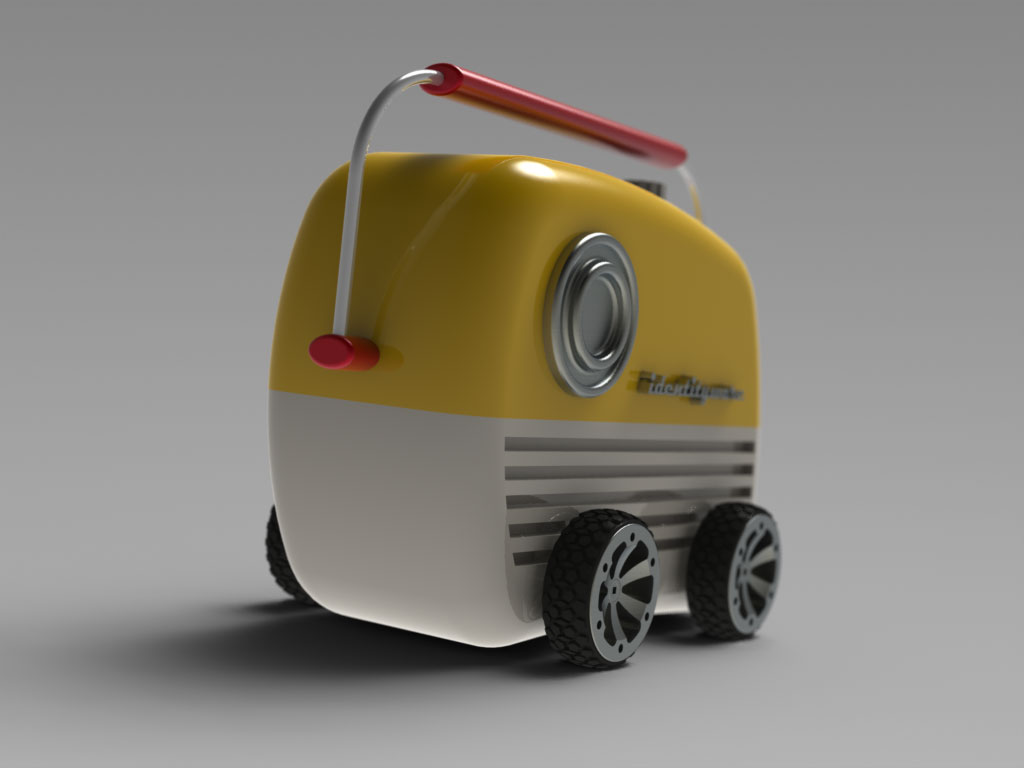
A test render of TST_003
Another test render of TST_003
Sensors and servos from Parallax, Chassis constructed with parts from Vex. CAD modeling in SolidWorks and Rhino. Renderings are real-time screen grab previews from PhotoView 360.
Labels:
cadcam,
criticaldesign,
designedobjects,
exhibition,
robot
Monday, December 28, 2009
Tea-house for Robots (project)
We (rootoftwo) are working on a project for the following exhibition:“Trouble in Paradise / The Ethics of Survival”
Date: Friday, July 9 – Sunday, August 22, 2010
International Symposium: “Creative Engagement / The Ethics of Survival”
Date: Part I: Saturday, July 10, Part II: Saturday, July 31
Location: The National Museum of Modern Art, Kyoto
It is a speculative space in a 'home of the future' where domestic appliances (robots) can go to recharge, update their firmware and generally get away from it all. The starting point for our robots are over-engineered, emotionally-durable, iconic products. You could say we are suckers for 'Raygun Gothic' - but we prefer the term 'SodaPop Chic'.
Karl Daubmann is working on the tea-house structure.
Labels:
designedobjects,
exhibition,
project,
robot
Friday, September 11, 2009
Smartsurfaces
University of Michigan's Smartsurfaces course offers a collaborative, project-based learning experience in which artists, designers, architects and engineers come together to build physical systems and structural surfaces that have the capability to adapt to information and environmental conditions.The course will operate as a multidisciplinary, hands-on think-tank where participants will pool their knowledge and skill sets to work together to produce environmentally sound and socially responsible projects. Public exhibition of these funded projects will provide an opportunity for participants to present their work to a wider audience and to review their achievements.
Projects will make use of the resources available to all participating university units, such as:
parametric modeling
digital fabrication
networked sensors
microcontroller programming
energy harvesting
The course begins September 11, 2009.
Labels:
architecture,
art,
cadcam,
design,
education,
robot,
rp,
technology,
transdisciplinary
Thursday, June 12, 2008
Ok, I'll bite...
A couple of videos that I watched recently that give a taste of what might be coming down the pipe.
Labels:
designedobjects,
innovation,
research,
robot,
technology
Wednesday, May 24, 2006
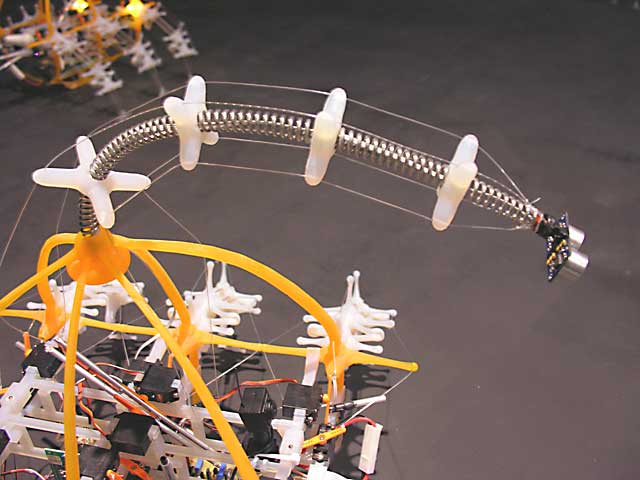
Rinaldo's Spider Bots (video)
Ken Rinaldo's and Matt Howard's Autotelematic Spider Bots can be seen in action in a featurette on the Ohio State University website: >Link<
Flash 8.0 is required to view the video.
My photos of the Spider Bots are here.
Flash 8.0 is required to view the video.
My photos of the Spider Bots are here.
Labels:
designedobjects,
project,
robot,
rp,
technology,
web
Thursday, March 09, 2006
Autotelematic Spider Bots


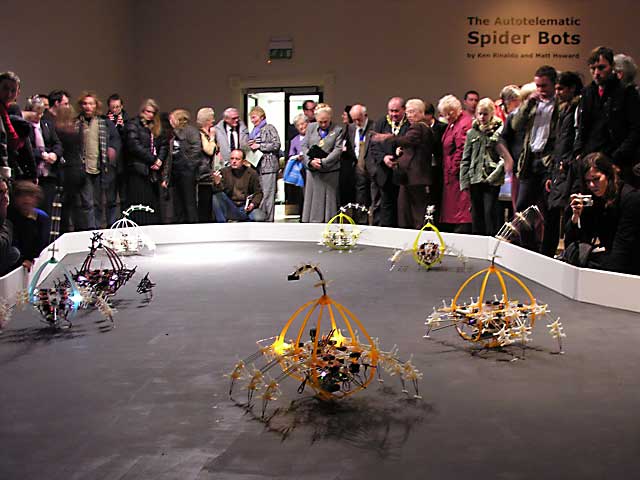
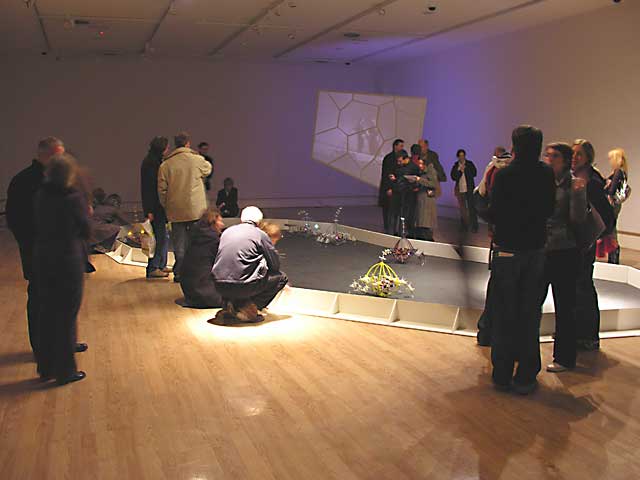
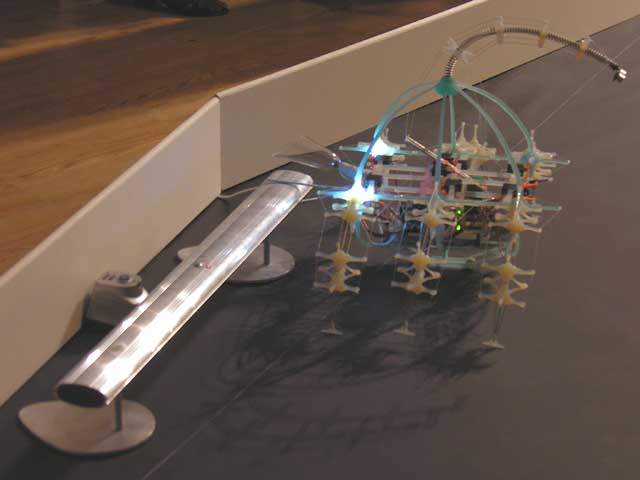
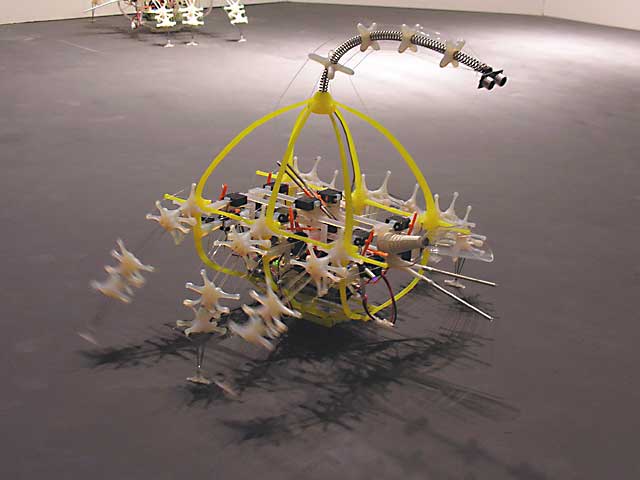
I attended the opening of Ken Rinaldo http://www.kenrinaldo.com/ & Matt Howard's Autotelematic Spider Bots show at Sunderland Museum & Winter Garden on Tuesday 7th March, 2006. The opening was really well attended. Almost too much so - I reckon all the activity on the sidelines was confusing the bots and it was really difficult to hear them communicating with one another. As the evening wore on and folks moved on to Andy Gracie & Brian Rowe's Autoinducer PH-1 (at the Northern Gallery for Contemporary Art) it was easier to hear them 'twittering like birds'. There seemed to be some teething problems with batteries running low - the bots didn't seem to want to stay at the feeding station to charge themselves up - I guess all the people waving things at them was kind of distracting. The bots themselves are amazingly elegant in their motion - more so than organic spiders that have that 'alien' quality to them.
From the position of the audience it is not immediately apparent what actions are triggering the behaviour of the bots and most people there just seemed happy that they were moving around. There are deeper levels of interaction between the bots, their environment and their audience that I think would only become apparent with more time than was available at the opening - definately an opportunity to play at being David Attenborough.
In 1966 Carl Andre wrote
'The course of development - sculpture as form; sculpture as structure; sculpture as place'.
As designed objects the Spider Bots are exemplary harbingers of the next evolutionary leap - sculpture as semi-autonomous entities.
The structure of the bots is amazing and equally impressive is the $50,000 of donated rapid-manufactured parts from http://www.laserrepro.com/ that it took to make them. The bots are also sponsored in-kind by http://www.parallax.com/
The Autotelematic Spider Bots will be at http://www.avfest.co.uk/ in Sunderland until 19th March. They will reappear in a solar-powered configuration later in the year in Sao Paulo, Brazil.
Labels:
art,
designedobjects,
exhibition,
robot,
rp,
technology
Subscribe to:
Posts (Atom)