Showing posts with label book. Show all posts

Friday, January 22, 2010

Undisciplinarity (essay in book)


The book that resulted from the 'inter_multi_trans_actions: emerging trends in post-disciplinary creative practice' symposium at Napier University in Edinburgh, Scotland on Thursday 26 June, 2008 is nearing publication.

The book 'Digital Blur: Creative Practice at the Boundaries of Architecture, Design and Art' edited by Paul Rodgers and Michael Smyth will now be published by Libri Publishing following Middlesex University’s decision to close Middlesex University Press.

According to Amazon the book is due on 31 March, 2010.

The book contains an essay by Julian Bleecker and myself that is preambled thus:

Marshall and Bleecker, in their essay, propose the term “undisciplinary” for the type of work prevalent in this book. That is, creative practice which straddles ground and relationships between art, architecture, design and technology and where different idioms of distinct and disciplinary practices can be brought together. This is clearly evident in the processes and projects of the practitioners’ work here. Marshall and Bleecker view these kinds of projects and experiences as beyond disciplinary practice resulting in a multitude of disciplines “engaging in a pile-up, a knot of jumbled ideas and perspectives.” To Marshall and Bleecker, “undisciplinarity is as much a way of doing work as it is a departure from ways of doing work.” They claim it is a way of working and an approach to creating and circulating culture that can go its own way, without worrying about working outside of what histories-of-disciplines say is “proper” work. In other words, it is “undisciplined”. In this culture of practice, they continue, one cannot be wrong, nor have practice elders tell you how to do what you want to do and this is a good thing because it means new knowledge is created all at once rather than incremental contributions made to a body of existing knowledge. These new ways of working make necessary new practices, new unexpected processes and projects come to be, almost by definition. This is important because we need more playful and habitable worlds that the old forms of knowledge production are ill-equipped to produce. For Marshall and Bleecker, it is an epistemological shift that offers new ways of fixing the problems the old disciplinary and extra-disciplinary practices created in the first place. The creative practitioners contained within the pages of this book clearly meet the “undisciplinary” criteria suggested by Marshall and Bleecker in that they certainly do not need to be told how or what to do; they do not adhere to conventional disciplinary boundaries nor do they pay heed to procedural steps and rules. However, they know what’s good, and what’s bad and they instinctively know what the boundaries are and where the limits of the disciplines lie.

Sunday, March 08, 2009

inter_multi_trans_actions preview (book)


inter_multi_trans_actions
Creative Practice at the Boundaries of Architecture, Design and Art
Edited by Paul Rodgers and Michael Smyth

[EDIT - the book is now called 'Digital Blur: Stories from the Edge of Creative Design Practice'.]

This book brings together ten of the world’s leading practitioners and thinkers from the fields of art, architecture and design who all share a common desire to exploit the latest computing technologies in their creative practice. The book reveals, for the first time, the working processes of these major practitioners’ work that breaks down traditional creative disciplinary boundaries. inter_multi_trans_actions provides a rich picture, both visually and textually, of the following ten leaders in the field – Jason Bruges Studio, Lucy Bullivant, Greyworld, HeHe, Crispin Jones, the Owl Project, the Pooch (BigDog Interactive), Bengt Sjolen, Troika, and Moritz Waldemeyer.

This book aims to inspire and inform any reader with an interest in design, architecture, art and/or technology and provides essential reading for any practitioner, researcher, educator, and/or other stakeholders involved in the creative arts and industries. The book provides a detailed insight into the techniques of these ten significant creative individuals and how they exploit the latest computing technologies in their work and the impact this will have for creative practice in the future.

• paperback
• ISBN: 978 1 904750 69 7
• 264pp
• 264 x 196mm
• £24.95
• Publication date: September 2009
• Middlesex University Press

Wednesday, March 04, 2009

inter_multi_trans_actions (book)


Inter_multi_trans_actions: Creative Practice at the Boundaries of Architecture, Design and Art (Paperback) by Paul Rodgers (Editor), Michael Smyth (Editor)
Paperback: 264 pages
Publisher: Middlesex University Press (1 Sep 2009)
ISBN-10: 1904750699
ISBN-13: 978-1904750697
Available to pre-order here.

Friday, February 27, 2009

Reading Material (books)

I've recently purchased a couple of books that I've been meaning to get for a while (too busy teaching/making stuff).


First up is the catalog from MoMA's Design and the Elastic Mind that features What's Cooking Grandma - the Human Beans project that we commissioned in 2006 for Perimeters, Boundaries and Borders. It is excellent. However, I was a little disappointed not to see Geoffrey Mann's piece Attracted to Light that was part of the MoMA exhibition (his Flight - Take Off was shown in PBB). I guess MoMA made up for this omission by acquiring the work (I'm quite proud of this, since I helped Geoff to make the Rhino file watertight).

No such oversight on the part of Troika. Their Digital by Design book is sumptious. (Also nice to see PBB mentioned in the section on Simon Blackmore).


This book is beautifully designed and well worth the investment. I'm now looking forward to the publication of the book from the inter_multi_trans_actions symposium (most of whom are included in Digital by Design). Julian Bleecker and I contributed a chapter to it.

Thursday, December 11, 2008

Sensory Urbanism Proceedings

This book contains papers from the January 2008 conference, Sensory Urbanism, held by the University of Strathclyde, Glasgow, UK. This conference was part of the Designing for the 21st Century Initiative project: 'Multimodal Representation of Urban Space'. This project is funded by the Engineering & Physical Sciences Research Council (EPSRC) and the Arts & Humanities Research Council (AHRC). I am on the advisory board of this project. Papers deal with issues surrounding the sensory perception of urban design and how to design better for all the senses. The book is illustrated throughout, and contains 26 papers from fields including architecture, urban design, environmental psychology, urban design, planning, sound design and more.

"Representing space is not only a long-standing challenge to the arts but is also a major task in the planning process for buildings, cities, and many other products. This particularly applies to the "Urban Renaissance" of our days with its emphasis on public places.

Space – more than the surrounding objects or buildings – seems to demand to be represented not only visually, as it is not only determined by the visible surrounding objects, but also by sound and smell which are literally "in the air", and by an integrated multimodal body experience which is related to the space itself. Nevertheless, spaces, especially urban spaces in planning processes, are today usually only represented in a visual manner.

The major hypothesis of our project is that much better results for convenient and appealing urban spaces could be achieved if all sensory factors were acknowledged and controlled during the design process. There is no doubt about the multimodal quality of urban space – it always appeals to all senses. For example the most beautifully designed public square is destroyed if a noisy and odorous motorway is nearby, and not much would be left of the special atmosphere of the Piazza della Fontana di Trevi in Rome if the sound and coolness deriving from the running water was missing. All these factors are usually poorly represented (if considered at all) during the design process, but such an appropriate representation could help create better public spaces.

How might such an appropriate representation of the multimodal qualities of urban space be achieved during the design process? Depending on this general question several sub-questions emerge: How can space be represented in general? What means of representing space have already been developed? What kind of design control could be achieved if the multimodal qualities of spaces were also included into the design process? What kind of creativity might be evoked by using methods of multimodal space representation? What affordable and practical technologies might be used in common design processes for spaces?"

For more information contact:

Dr Raymond Lucas
Postdoctoral Research Fellow
Department of Architecture
University of Strathclyde
Room G28, Architecture Building
131 Rottenrow
Glasgow, G4 0NG

raymond.lucas@strath.ac.uk

The Sensory Notation Handbook will be available soon, with the first edition detailing the notational system and providing 30 case studies from Rome, Tokyo and Boston. An expanded edition of 50 studies - including Glasgow and Edinburgh will follow.

Tuesday, June 03, 2008

Ira Greenberg

At the the CPATH workshop I also met Ira Greenberg - a practitioner with a background as eclectic as my own. Ira gave a fascinating presentation. He talked about a moment that happened after he had been using computers for a while when he became bothered by not knowing what was going on 'under the hood' - this resonated strongly with me. Ira also made a distinction between 'digital immigrants' and 'digital immersives' (aka Digitial Natives, Gen Y, Millenials, Next Generation of Workers). This is something that is becoming all too apparent to me. In a breakout session at the workshop I brought up the fact that it seems that the education industry is in the same position as the music, news and broadcasting industries - in that they are in the process of being remediated and generation-gapped (and for the most part don't seem to know it yet). The discussion was swiftly shepherded back to the quandary facing Computer Science (that I would argue is just a subset of my overarching point). Another interesting point made by Ira was that in art and design education the only failure is a lack of engagement.

Wednesday, May 21, 2008

PBB Book (finally) Published

The 'Perimeters, Boundaries and Borders' publication (ISBN 978-0-652-355-2) is now available. You can buy a printed copy (for $18.95 US) or download it (full resolution, no cover, 80 MB) for free.

'Perimeters, Boundaries and Borders' was made possible through funding and support from Arts Council England, Manchester Institute for Research and Innovation in Art and Design (MIRIAD) and Lancaster City Council. 'Perimeters, Boundaries and Borders' was presented by Fast-uk in partnership with folly as part of the f.city festival of digital culture in 2006. The publication is supported by MIRIAD.

[N.B. If you were involved in the show I will be getting copies to you in the near future. If your contact details have changed please get in touch and let me know].

Wednesday, May 14, 2008

PBB (Book) Update

The PBB book proofs just arrived. Even though I've been working on it for eighteen months, I'm impressed. They are much slicker and the printing quality is higher than I had expected. It should be available later this week...

Tuesday, May 13, 2008

Sunday, April 27, 2008

Design Fiction (book)

"It is a book of "design fictions." By deliberately creating objects that cannot exist -- because the material is not yet available, or the business plan, or the manufacturing process, or the infra- structure to support it, or even the human sensibility -- it becomes possible to explore the meaning of design at a more profound level and to think more richly about what is and what might be.

The principal objective of the book is to stimulate thought: What is an object? Why do we desire what we desire? Why has "functionality" been defined in such a historically narrow way? What is beauty? Nonobject is an attempt to free the imagination by disengaging it form the constraints of utility, economy and technology."

nonobject

Thursday, April 17, 2008

Product Scotland (book)

A book has been published (ISBN 978-0-9558468-0-9) as a way of recording and sharing the results of the 4 Product Scotland workshops held at the end of 2007 (more information here). There are lots of pictures, participant comments and some essays in it. These are:

'Design Ethnography for the 21st Century' by Paul Rodgers & Mike Anusas.
'I Love Digital' by Jon Rogers.
'Ontologies of Production: 21st Century Transformations in Manufacturing' by me.
'Creativity - Preaching to the Converted' by Craig Whittet & Alex Milton.

I'm not sure how the book is being distributed but if you have to have a copy, contact:

Dr Paul A. Rodgers
Reader in Design
School of Creative Industries
Napier University

Friday, November 09, 2007

The Fundamentals of Digital Art (book)


I just received a copy of Richard Colson's book 'The Fundamentals of Digital Art' that is to be published on 27 November, 2007 (I got a copy because I contributed some photos).

My first impression of the book is that it is an informative and visual overview of key practitioners and critical issues in the field. This is what the publisher has to say:

"The book provides an overview of digital art and offers careful explanations of physical computing, using data sources, programming, networks for artists and experimental practices in digital art. The text is accompanied by extensive illustrations, ranging from work by recognised practitioners in the field to current student work from undergraduate programmes. It also includes practical clear workshop diagrams designed to help students develop the confidence to work with the approaches covered in the book themselves."

The book is broken into the following sections:
  • Introduction
  • The history and development of digital art
  • Live art: using response
  • Data into art
  • Creative priorities for coding
  • Art and networks
  • Digital hybrids
  • Postscript (including a list of resources and links)

It seems well worth a look and I look forward to reading it in depth.

Monday, May 21, 2007

Recommendations (books)

Another couple of books worth getting or having a look at. Marcus Fairs' Twenty-First Century Design [Carlton Books ISBN 1-84442-269-0] is one of those sumptious, full-coloured compendiums that makes you reach for your wallet the moment you clap eyes on it. There won't be much new in it for you if you read icon regularly but it certainly takes up less space than 7 years worth of magazines. Made all the better for having Banksy, the Honda [Grr] commercial and Grand Theft Auto in it.

Alex Coles' Design and Art [Whitechapel and MIT Press ISBN 978-0-262-53289-1] is a great collection of essays by various practitioners working in the interzone between these areas. As indicated in his introduction, Coles seeks to go beyond his previous publication DesignArt [Tate Publishing ISBN 1-85437-520-2] since he now considers the term 'designart' to refer

"...to something much more limited in scope..."

I personally had a bit of a problem with Coles' interpretation of 'DesignArt' anyway - it is not a reciprocal term - you cannot have 'ArtDesign.' I much prefer Dan Graham's 'Art as Design/Design as Art' (1986) or Troels Degn Johansson's 'Art in the Context of Design, Design in the Context of Art.' Coles' use of 'simultaneity' in reference to the nature of hybrid practice seemed much more 'contingent' to me. But then, I do subscribe to the

"...indolent meta-critical reflection..."

school of thought (Duchamp for example). I will be talking about this at The Fruitmarket Gallery in Edinburgh next month:

Dan Graham’s Art as Design/Design as Art 19 June, 6.30–7.30pm. This talk marks the 20th anniversary of the publication by Dan Graham and The Fruitmarket Gallery of the text ‘Art as Design/Design as Art’ which explored the sources of Graham's work Interior Design for Space Showing Videotapes, 1986. This talk will look at contemporary art practice in the context of this important text and coincides with an exhibition of four films by renowned Dutch artist Aernout Mik.

Monday, May 14, 2007

Emerging Technologies (book)

Emerging Technologies and Housing Prototypes is a guide to new materials and technologies being used by architects.
Black Dog Publishing (27 April 2007)
ISBN-10: 190477265X
ISBN-13: 978-1904772651
Link to Black Dog Publishing page

This is an interesting book [even if the introductory essays are a little strange - lost in translation, maybe?] It is a good resource. I particularly like the tables at the start of each section that graph the properties and applications of the materials under the following headings:

Shape Performance
Optical Performance
Sustainable Performance
Integrated Performance
Responsive Performance
Material Profile
Process Technique
Case study Applications

The criteria used to determine innovative materials are:

It is non-polluting during the production process
It has been realised with low cost-effect technology
It is fully tolerable, recyclable and biodegradable
It is easy to stock
It is lightweight while maintaining high mechanical strength
It adds together properties of several materials (composite and nanocomposite materials)
It is obtained through technological transfer coming out of application from a different field

Friday, January 12, 2007

Design and Art (book)

This reader in Whitechapel's Documents of Contemporary Art series investigates the interchange between art and design. Since the the Pop and Minimalist eras--as the work of artists ranging from Andy Warhol to Dan Graham demonstrates--the traditional boundaries between art and architectural, graphic, and product design have dissolved in critically significant ways. Design and Art traces the rise of the "design-art" phenomenon through the writings of critics and practitioners active in both fields.
The texts include writings by Paul Rand, Hal Foster, Miwon Kwon, and others that set the parameters of the debate; utopian visions, including those of architect Peter Cook and writer Douglas Coupland; project descriptions by artists (among them Tobias Rehberger and Jorge Pardo) juxtaposed with theoretical writings; surveys of group practices by such collectives as N55 and Superflex; and views of the artist as mediator--a role assumed in the past to be the province of the designer--as seen in work by Frederick Kiesler, Ed Ruscha, and others. Finally, a book that doesn't privilege either the art world or the design world but puts them in dialogue with each other.

Contributors: David Bourdon, Peter Cook/Archigram, Douglas Coupland, Kees Dorst, Charles Eames, Experimental Jetset, Vilém Flusser, Hal Foster, Liam Gillick, Dan Graham, Clement Greenberg, Richard Hamilton, Donald Judd, Frederick Kiesler, Miwon Kwon, Maria Lind, M/M, N55, George Nelson, Lucy Orta, Jorge Pardo, Norman Potter, Rick Poynor, Paul Rand, Tobias Rehberger, Ed Ruscha, Joe Scanlan, Mary Anne Staniszewski, Superflex, Manfredo Tafuri, Rirkrit Tiravanija, Paul Virilio, Joep van Lieshout, Andy Warhol, Benjamin Weil, Mark Wigley, and Andrea Zittel.Alex Coles is a London-based art critic and lecturer. He is the author of DesignArt and a regular contributor to Art Monthly, Contemporary, Parachute, and Artext.

LINK

Tuesday, January 02, 2007

New Media Architecture

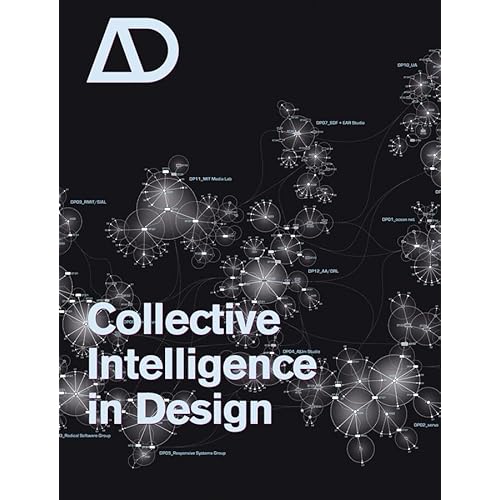
Collective Intelligence in Design: New Forms of Distributed Practice and Design
by Chris Perry (Editor), Christopher Hight (Editor)

Exploring how today's most compelling architecture is emerging from new forms of collaborative practice, this title of AD engages three predominant phenomena: architecture's relationship with digital and telecommunication technology; the media; and economies of globalisation. The articles in the issue explore the relationship between these readings and examine, for the first time, the implications of these phenomena upon forms of architectural invention and production. While much attention has been focused upon the influence of digital media on architectural form and technique, little has examined its far broader implications for forms of architectural practice. Yet, as with modernism and the professionalization of architecture at the end of the 19th century and the rise of architectural corporations in the mid-20th century, the future of architectural design will inevitably depend upon reconfigurations of architectural authorship.

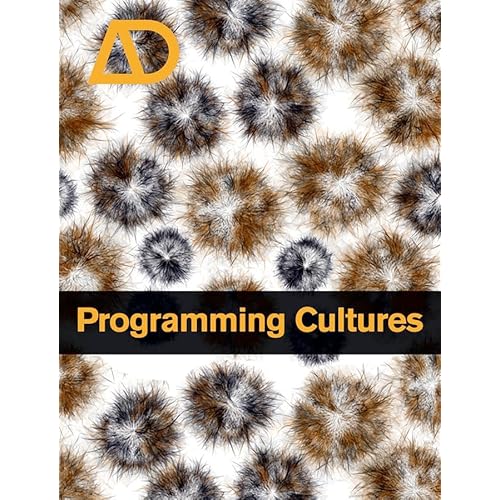
Programming Cultures: Architecture, Art and Science in the Age of Software Development
by Mike Silver (Editor)

"Programming Cultures" explores the relationship between software engineering and the various disciplines that benefit from new codes and programming tools. The title focuses on a range of practices including: aviation design, urban infrastructure simulation, Hollywood special effects, nanotechnology, mathematics and architecture. In terms of building design, "Programming Cultures" specifically examines the potential of new software designed to solve specific visualization and data processing problems from within the profession. The book allows architects to become more familiar with programming rather than basing their work on appropriated systems designed for non-architectural applications (Maya, 3D Studio MAX etc.) and will become a primer for an emerging culture of students; academics and young professionals that are starting to outgrow the predetermined structure of today's most popular modeling and animation packages.

Wednesday, August 09, 2006

Responsive Environments (book)

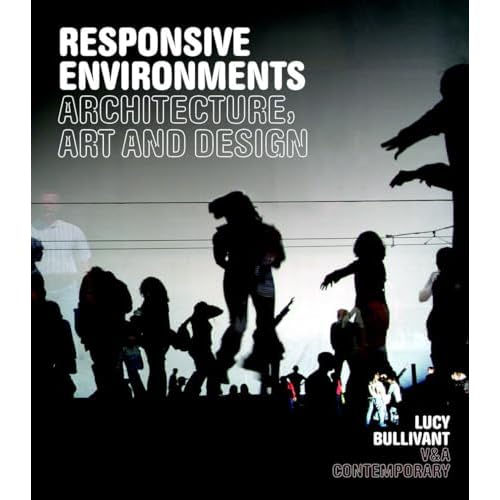
Responsive Environments: Architecture, Art and Design
by Lucy Bullivant
V & A Publications (15 May 2006)
ISBN: 1851774815

"Artistic manifestations of the use of digital technology in physical spaces are growing. Electronic billboards have been around for decades, but now the concept of connectivity has also literally seeped into the skins of buildings in new ways. Artists - and architects working in hybrid fields on interactive projects - are responding to the electro-physical flux of urban environments, coopting responsive dynamic media systems, wireless sensing, wearable computing and even topological media. They proactively consult scientific institutions to dig deeper into their environmental interests, and are not interested in 'tech' or smart spaces for the sake of it, but to create environments that act as mediating devices for a new social statement.

Drawing on interviews by the author with the designers, architects and artists featured - including Jason Bruges, Lars Spuybroek, Scott Snibbe, Diller + Scofidio, Ben Rubin, Rafael Lozano Hemmer, David Small, Christian Moeller, Usman Haque, HeHe, Electronic Shadow, Shona Kitchen and Ben Hooker, Stefano Mirti and Walter April, Casson Mann, Golan Levin, Sponge (Chris Salter, Sha Xin Wei, Laura Farabo), Toyo Ito, UN Studio, Mark Goulthorpe, Toshio Iwai and KDa, Maywa Denki, Sociable Media Group (MIT), d-squared, Allofus, Kas Oosterhuis, Tobi Schneidler, Décosterd + Rahm, Realities:united, Adam Somlai-Fischer and Mette Ramsgard Thomsen - this unique account sheds fresh light on the way new technologies are being harnessed, amidst a cultural context of growing multidisciplinary activity in art, architecture and design during the last 15 years."

Thursday, June 29, 2006

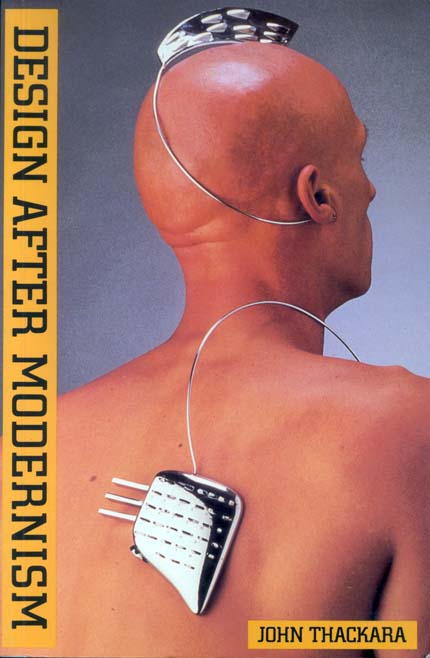
Design After Modernism (book)

After reading a couple of references to John Thakara's 'Design After Modernism' I ordered a used copy which arrived yesterday. I'm really glad I did because it looks like it covers a lot of the precedents for the work I am doing in my research. I really found a lot of value in Thackara's latest 'In the Bubble'. I think 'Design After Modernism' might be out of print because I could only find used copies online. I also could not find a table of contents for it. So in the interests of public service:

CONTENTS
Preface.
INTRODUCTION
1 . Beyond the object in design.
JOHN THACKARA
2 . The experience of modernity.
MARSHALL BERMAN
CITY - BUILDING - STREET
3 . Place-form and cultural identity.
KENNETH FRAMPTON
4 . A city is not a tree.
CHRISTOPHER ALEXANDER
5 . Architecture and cognac.
RICHARD BOLTON
6 . Street signs.
NIGEL COATES
PRODUCT - ORNAMENT - CRAFT
7 . The search for a postmodern aesthetic.
PETER FULLER
8 . The ideal world of Vermeer's little lace maker .
PETER DORMER
9 . Design and 'avantpostmodernism'.
FRANCOIS BURKHARDT
10 . Invisible design .
CLAUDIA DONA
11 . Culture as commodity: style wars, punk and pageant.
PETER YORK
TECHNOLOGY - SOFTWARE - PROCESS
12 . The system of objects.
JEAN BAUDRILLARD
13 . From Socrates to Intel: the chaos of microaesthetics.
THIERRY CHAPUT
14 . The demise of classical rationality.
PHILIPPE LEMOINE
15 . From Brunelleschi to CAD-CAM.
MIKE COOLEY
16 . The product as illusion.
TOM MITCHELL
17 . Softecnica.
JOHN CHRIS JONES

THACKARA, J., 1988. Design after Modernism. London: Thames & Hudson.

Blog Archive

My Portfolio

John Marshall Portfolio

My Linkedin Profile

View John Marshall's profile on LinkedIn

rootoftwo's shared items

About

I am exploring a hybrid form of art and design practice through the use of computer-based design and fabrication tools. I am interested in experimental objects and spaces that are dynamic and responsive and seek to challenge perceptions, expectations and established behavior.

Creative Commons

My del.icio.us

Site Meter