Showing posts with label rp. Show all posts

Monday, December 28, 2009

SmartSurfaces 1.0 Complete

Smartsurfaces_final019

The University of Michigan SmartSurfaces course is now complete. It was a collaborative, project-based learning experience in which undergraduate artists, designers, architects and engineers came together to build physical systems and structural surfaces that have the capability to adapt to information and environmental conditions.

The course was broken into two phases: an introductory / skill building phase, and the final project. For the first part of the course, participants focused on problem and constraint definition, structured brainstorming and skill building. Final teams were assigned in week six and the rest of the semester involved the production of the fully realized, funded projects shown below. Both phases focused on multidisciplinary, collaborative teams to carry out the assignments and projects. An important aspect of this course was the manner in which useful cross-fertilization emerged in the application of different disciplinary methodologies in response to concrete problems in practice.

Course participants had the opportunity to gain experience with using diverse tools and processes. Where possible, learning made use of practical problem solving through experimentation. All participants were challenged beyond their usual intellectual and disciplinary boundaries and had to negotiate and manage differences between the cultures of three university units (Art & Design, Architecture and Materials Science Engineering).

Each team was required to design, build, program and test a ‘heliotropic smartsurface’ that made use of:
Solar energy harvesting
Microcontroller programming (with Arduino) and circuit building
Parametric modeling (with Digital Project)
Digital fabrication

The teams had to consider and negotiate what makes a surface smart, and why we would be interested in a smart surface that follows the Sun. They had to engage a methodology of defining explicit relationships, complex behaviors, and unforeseen responses in a context of distributed authorship.

This is what they came up with:

Smartsurfaces_final000

The Shy Solar Array: An Adaptive Solar Array That Responds To Weather
Arrays of solar cells are vulnerable to their surroundings, do not maximize the sunlight-collecting surface area, and are unattractive. Inspired by the Mimosa Pudica plant and its tendency to shy away from external stimuli, our shy solar array was created. Our solar array protects itself from damaging elements such as snow or rain by flipping away from them. This will allow the solar array to be implemented in less than ideal weather locations, such as Michigan. Our solar array also maximizes the sun collecting surface area through its unique shape. The form of the array lends itself to a more efficient use of surface area by avoiding shadowing when the cell is rotated towards the sun. Also, the array stands out as a more desirable object that can serve as a stand-alone artifact as well as a useful solar array. Outside of the gallery this solar array would be implemented onto the rooftop of Michigan Engineering buildings as an alternative energy source. To further maximize the collected energy, the solar array should contain solar cells that are specially shaped to the design.

Team Fabric + Super J
Alyssa Ackerman – School of Art and Design
Johanna Brand – Taubman College of Architecture and Urban Planning
Yuming Jiang – Material Science and Engineering
Chris Johnson – Taubman College of Architecture and Urban Planning
Mat Schwartz - School of Art and Design
Michelle Svetkoff - Material Science and Engineering

Smartsurfaces_final003

The iWall Modular Light-Filtration System
The wall you see here is a modular, scalable, self-adjusting multi-aperture window, designed to optimize light flow into a room by manipulating the position of rotating wood panels. You could call it an 'automatic venetian blind', as that is the gist of the purpose. The system consists of 30 individual modules, with one panel per module, which allow a variable amount of light to pass through. The structural elements are built modularly, but circuitry elements - such as wiring - are set up in a non-modular fashion. Individual module apertures open and close in reaction to the intensity of the light that passes through the wall as detected by light-dependent resistors (LDRs), seen on the projection side, holding a relatively constant light level on the ‘interior’ of the wall at all times - this gives 'heliotropic' and 'smart' characteristics to the wall - 'surface', fitting it into the premise of the SmartSurfaces course. The actual actuation is by a grid of servos powered externally and controlled through inputs from an Arduino Mega and the LDRs. The materials used in the assembly of the individual modules were 3/16" cast acrylic cut by laser and 3/16" 6061 aluminum sheet cut by water jet.

Team iWall
Westley Josiah Burger
- Taubman College of Architecture and Urban Planning
Peter Hall - School of Art and Design
Brieana MacDonald - Taubman College of Architecture and Urban Planning
Michael Mathieu - Material Science and Engineering
Taylor McKenzie-Veal - School of Art and Design
Neil Poulin - Material Science and Engineering

Smartsurfaces_final013

Simon
Simon is a heliotropic, feel-good machine. He interacts with a user through motion and LED color mixing and enters a default solar-tracking mode when not in use. Face recognition technology, a simple joint system, and a flexible LED array make possible a wide range of movement and interaction while photovoltaic panels provide the power. By fusing emotional connections with the user, we hope to transform the concept of sustainability from a condition of sacrifice to that of pleasure.

Team Softcore
Rachel Boswell - School of Art and Designn
Eric Harman - School of Art and Design
Marc Maxey - Taubman College of Architecture and Urban Planning
Lindsey May - Taubman College of Architecture and Urban Planning
Damien Stonick - Material Science and Engineering
Zilin Wang - Material Science and Engineering

Smartsurfaces_final018

Exposure
Rather than using solar cells to convert sunlight into electrical energy, we are concerned with using the power of the sun in a more direct way. Exposure is a biological, heliotropic lighting system powered by photosynthesis. Living inside the piece are several Dinoflagellates, Pyrocystis fusiformis, aka bioluminescent algae. The bioluminescence of the organisms are set to a biological clock quite similar to our sleep cycle. During 12 hours of daylight Pyrocystis use the available light to photosynthesize, producing their own food and oxygen. At sunset the cells produce the chemicals that cause the luminescent reaction. If agitated during their 12-hour dark cycle, the algae give off a glowing blue light. In Exposure we have harvested several bioluminescent algae organisms, and embedded them into an architectural array. Within the array, varying panel heights correspond to the density of algae organisms contained in each unit. Infrared sensors located below the panels detect human presence, and trigger a motor. Attached to the motors, a cam makes contact with the panels creating enough motion to agitate the algae and expose their bioluminescent glow.

Team Slime
Ivan Adelson - Taubman College of Architecture and Urban Planning
Aidan Feldman - Computer Science Engineering & Department of Dance
Isaac Krauss - School of Art and Design
Laura Ligeski - Material Science and Engineering
Allison Sturm - School of Art and Design
David Theisz - Taubman College of Architecture and Urban Planning

The course will be offered again in Fall 2010.

Friday, September 11, 2009

Smartsurfaces

University of Michigan's Smartsurfaces course offers a collaborative, project-based learning experience in which artists, designers, architects and engineers come together to build physical systems and structural surfaces that have the capability to adapt to information and environmental conditions.

The course will operate as a multidisciplinary, hands-on think-tank where participants will pool their knowledge and skill sets to work together to produce environmentally sound and socially responsible projects. Public exhibition of these funded projects will provide an opportunity for participants to present their work to a wider audience and to review their achievements.

Projects will make use of the resources available to all participating university units, such as:

parametric modeling
digital fabrication
networked sensors
microcontroller programming
energy harvesting

The course begins September 11, 2009.

Monday, April 21, 2008

Digital Design Futures (exhibition)

Automake and Future Factories: Digital Design Futures is an exhibition that explores the significant role of digital design in the creation of contemporary craft and design.

Automake presents the work of Justin Marshall, a craftsperson/maker whose research investigates the integration of a range of digital technologies into ‘traditional’ art and craft practices, leading to the creation of innovative new work.

FutureFactories presents the work of Lionel Theodore Dean, who has acted as a consultant to the transport and interior products industry for twenty years. His research is based around the use of rapid prototyping for the mass individualisation of products.

The exhibition is at The Hub (national centre for craft & design) in Sleaford, Lincolnshire from 3 May - 8 June.

Sunday, February 17, 2008

Experiential Extensions (event)


Experiential Extensions - February 13 - 27, 2008.

Duderstadt Center,
University of Michigan,
2281 Bonisteel Boulevard,
Ann Arbor, MI 48109-2094

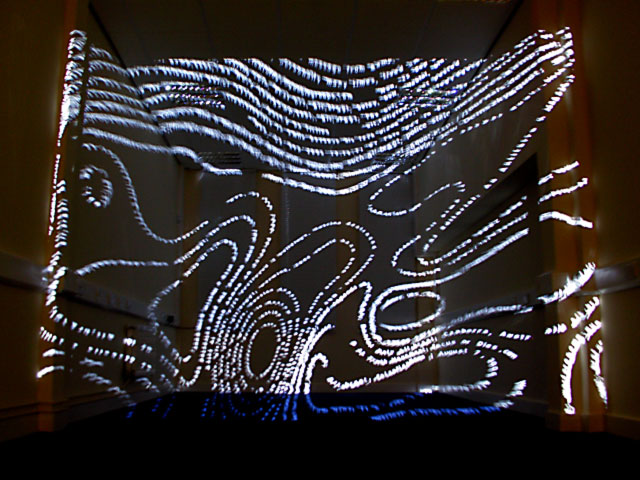
Edward S. Johnston's MFA thesis exhibition presents digital animations, photographs, and 3D printed objects that explore the path from his apartment to the School of Art & Design in Ann Arbor, Michigan. Ed has taken regions from photographs taken on the route to campus and used these profiles to create 3D forms and animations where the relative cross-sections (taken from the photos) are placed along a path relative to their distance from each other on the journey.


More images of Ed's show here.

Thursday, June 07, 2007

Bursaried MPhil/PhD Studentship (Falmouth)

3D Digital Production Research Degrees (MPhil/PhD)

Applications are invited for research degrees (MPhil/PhD) in the area of 3D digital production.

Project proposals should focus on one of the following:
• innovative methods of integrating digital technologies into the creative processes of designing and making;
• online design tools/environments that facilitate collaboration between design professionals and designers, or designers and consumers, for customisation of 3D digital production;
• intuitive/human centred methods of interfacing with 2D/3D Computer Aided Design software and Computer Aided Manufacturing hardware that facilitate collaborative and customised 3D production.

A small number of studentships are available with bursaries covering UK/EU fees and a stipend of £12,000 p.a.

For more information see www.autonomatic.org.uk or for an informal discussion contact Dr Katie Bunnell on 01326 370497.

Deadline for applications: 11 July 2007.
Interview date: 26 July 2007.

Application forms can be downloaded from the website at: www.falmouth.ac.uk/courses/research

Hard copies are available on request by emailing:
admissions@falmouth.ac.uk.

Thursday, May 03, 2007

Neil Gershenfeld @ TED (video)


Although I have been a huge fan of Neil Gershenfeld's work since I read his book 'Fab: The Coming Revolution on Your Desktop' I hadn't seen this presentation from TED until I saw it over at the Ponoko Blog. The presentation condenses the book into 18 minutes with plenty of examples.

Towards the end of the talk Gershenfeld indicates that the 'looming bug' of Moore's Law in the transition from 2D to 3D becomes the 'ultimate feature'. Fantastic stuff!

Elsewhere on the web Bruce Sterling posted a link to the article The Transformation of Manufacturing in the 21st Century by Lawrence J. Rhoades which is worth a read. Intrigued by the term “Innofacturing™” in the article I Googled it to find a place-holder for the innofacturing.com home page. Interesting.

[Rhoades is president and chief executive officer of Ex One Corporation whose ProMetal Division produces systems specifically dedicated to making metal components. Fast-uk President Keith Brown once had ProMetal take a look at building one of his sculptures. I think he was having problems with the internal geometry of the piece. I'll have to ask if it ever got built.]

Friday, April 27, 2007

Monday, April 23, 2007

(Post)Industrial Revolution 2.0?

Watch out here it comes...

Fab at Home is a website dedicated to making and using fabbers - machines that can make almost anything, right on your desktop. This website provides an open source kit that lets you make your own simple fabber, and use it to print three dimensional objects. You can download and print various items, try out new materials, or upload and share your own projects. Advanced users can modify and improve the fabber itself.

Fab at Home in The Guardian.

The Evil Mad Scientist 3D Printer Project and here.

What Do YOU Want To Make?

"TechShop is a fully-equipped open-access workshop and creative environment that lets you drop in any time and work on your own projects at your own pace. It is like a health club with tools and equipment instead of exercise equipment...or a Kinko's for geeks.

TechShop was founded in 2006 by Jim Newton, a lifetime maker, veteran BattleBots builder and former MythBuster. TechShop is located in Menlo Park, California, on the San Francisco peninsula 25 miles south of San Francisco.

Anyone can come in and build and make all kinds of things themselves using the TechShop tools, machines and equipment, and draw on the TechShop instructors and experts to help them with their projects.

TechShop is designed for everyone, regardless of their skill level.
TechShop is perfect for inventors, "makers", hackers, tinkerers, artists, roboteers, families, entrepreneurs, youth groups, FIRST robotic teams, arts and crafts enthusiasts, and anyone else who wants to be able to make things that they dream up but don't have the tools, space or skills.

The TechShop workshop provides a wide variety of machinery and tools for the open and unlimited use of its members, including milling machines and lathes, welding stations and plasma cutters, sheet metal working equipment, drill presses and band saws, industrial sewing machines, hand tools, plastic working equipment, electronics design and fabrication facilities, tubing and metal bending machines, electrical supplies and tools, and pretty much everything you'd ever need to make just about anything all by yourself."

Discovered here.

TechShop site here.

This looks fantastic. We need more FabLabs like this everywhere.

Tuesday, April 03, 2007

DIRL (visit)

While I was in the US recently, Elona Van Gent and I visited OSU Department of Art's Dimensional Imaging Research Laboratories (DIRL). We were given a tour by Ken Rinaldo, Amy Youngs and Todd Slaughter. We were also shown around The Knowlton School of Architecture's Digital Fabrication Lab by Matt Bernhardt.

We also met with Christos Yessios at AutoDesSys to discuss the 3D morph tool in FormZ.

Thursday, March 22, 2007

Ed Johnston

I enjoyed meeting and seeing the work of Ed Johnston at the UM3D Lab. Ed is working on his MFA. He has been creating some interesting RP sculptures from 2D images. Ed has also been doing some interesting work with researchers in the Center for Live-Cell Imaging (CLCI) at the University of Michigan about making virtual environments of their microscopic data.

Saturday, February 24, 2007

Fabrications (event)

I will be contributing to Elona Van Gent's Advanced Studio Art course at The University of Michigan's School of Art & Design (as a Roman J. Witt Visiting Artist) in March, 2007. Here is an excerpt from the syllabus:

Fabrications: Constructing and Construing
Art 300 (19) Advanced Studio Topic
Instructor: Elona Van Gent, Associate Professor

"Fabrications is an advanced studio involving the exploration of three-dimensional objects in both physical and digital realms. Our point of departure is the multiple meanings of the word fabricate, meanings that suggest both constructing and construing. Fabricating an object involves making something by means of combining or assembling parts. It is a term often (but not exclusively) associated with additive material processes used in building and manufacturing.

Three-dimensional computer technologies are characterized by attributes that both mimic the world around us and defy its limitations. They therefore provide ideal environments for exploring fabricated things. Digital 3-d modeling, animation, scanning, laser cutting, and rapid prototyping will be used in conjunction with traditional sculptural media such as wood, metal, and plastics".

This course is pitched on the point of tension between traditional haptic skills whilst gaining the necessary digital competencies to be able to integrate these new technologies into the practice of making. I think it will be very interesting to see what happens.

Wednesday, February 07, 2007

Digital Explorers ll (event)

University College Falmouth and Metropolitan Works present:

Digital Explorers ll
A series of evening events in conjunction with
Autonomatic, an exhibition of digital design from the
3D Digital Production Research Cluster at UCF
7–15 March 2007.

Metropolitan Works
Creative Industries Centre
41 Commercial Road
London E1 1LA
020 7320 1827
For more information visit:
http://www.autonomatic.org.uk/de_programme.htm

The programme consists of presentations from design practitioners, craftspeople, researchers and technologists. Each evening is themed around the use of digital technology in ceramics, textiles, interiors and architecture, metalwork and jewellery, with some talks featuring demonstrations of cutting-edge digital equipment.

With the aim of inspiring and encouraging further exploration, the 3D Digital Production research cluster at UCF and Metropolitan Works have joined forces to offer this comprehensive programme, introducing innovative creative practices that integrate digital production techniques with established making processes. The cluster supports research that aims to ‘humanise’ processes of digital production such as: digitally capturing human gesture for the development of 3D forms; 'crafting' with 2D and 3D CAD software; and 'drawing' 3D surfaces using computer numerically controlled machinery. Metropolitan Works Creative Industries Centre supports the exploration of new technology in opening up exciting new areas for production and creativity.

Places are free but strictly limited and bookings must be made in advance. Please contact Metropolitan Works to register your place. Tel 020 7320 2832 or email info@metropolitanworks.org

Thanks to Justin Marshall for the info.

Monday, January 29, 2007

RP for 10K US?

"The 3D Systems Corporation has released information about its V-Flash Desktop Modeler, which the company plans to introduce this summer. Although the 25 x 26 x 27-inch, 100-pound machine is a bit heftier than your average inkjet printer, it points toward the day when you’ll be able to “print” your own little 3D models, parts and prototypes as inexpensively as a photograph today. Today, the compact, self-contained V-Flash can produce accurate, stereolithography (SLA)-like 3D models made of a photocurable plastic material 'within hours.' (Photocurable means that the material cures with a photo light source.) The printer accepts standard CAD formats like .stl. Models can be as large as seven by nine inches and nearly eight inches tall. The company plans to offer additional materials later this year. Price for the V-Flash? US$9,900."

http://www.modelin3d.com/

Wednesday, December 13, 2006

Seminar, Guldagergaard, Denmark

I've been invited by Flemming Tvede Hansen (a PhD scholar in the field of ceramics, working in Copenhagen, Denmark www.flemmingtvede.dk) to participate in the following seminar:

In the cross-border of digital media and physical form
Seminar, Guldagergaard, www.ceramic.dk , 3/2-4/2 2007:

The idea about this seminar is to meet people working in the cross-border of digital media and physical form. The aim of the seminar is to make an interdisciplinary network for exchanging knowledge, - show and share, - so new hybrids fields and approaches can appear.
The meeting will be structured by presentations of works and issues on the use of digital media from the participants. The participants are invited according to their use of digital media as a base or a catalyst for a physical product or art piece.

THEME: The relationships between the digital media and physical form in your project.
How is the physical media related to the work in the digital media?
How is ones knowledge about the physical media utilized in the digital media?
How is the interaction between the physical and digital media in the creative process?
What do the digital media add in an artistic sense?

PLACE: Guldagergaard, Heilmannsvej 31A, 4230 Skælskør, DENMARK

Thursday, October 19, 2006

.MGX by Materialise


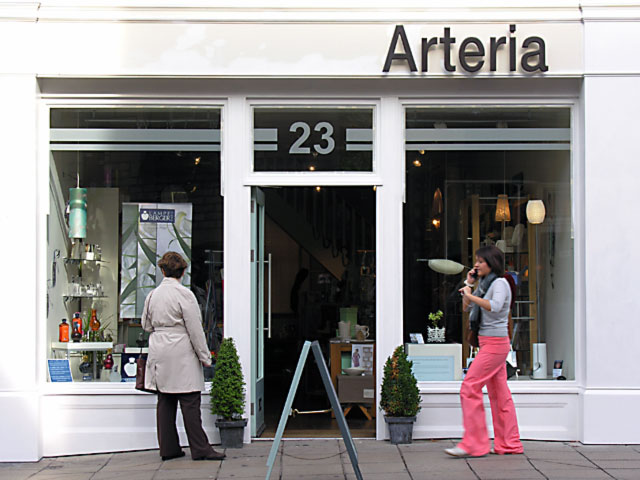
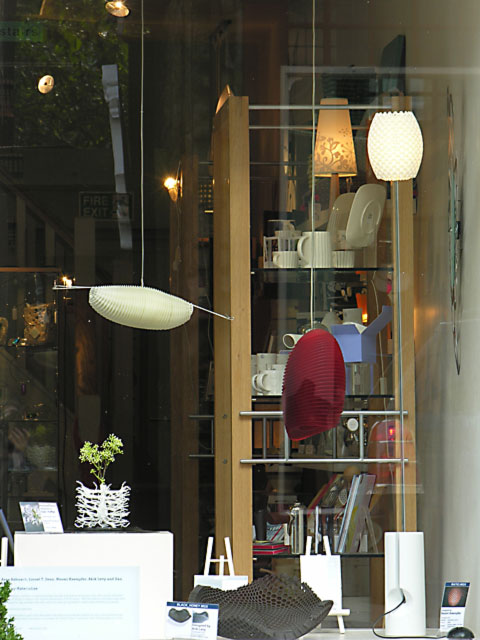
There are 5 pieces from the PBB show located just around the corner from CityLab in the satellite venue Arteria, 23 Brock Street, Lancaster, LA1 1UR, Tel: 01524 61111.
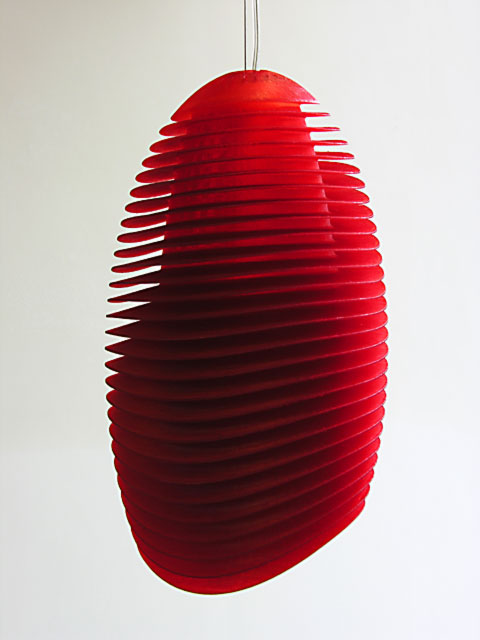
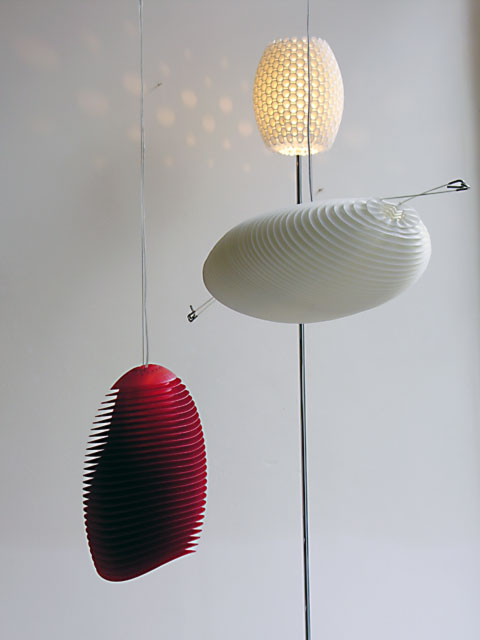
The works in Arteria are by: Assa Ashuach (‘Omi’), Naomi Kaempfer (‘Ratio’), Dan Yeffet (‘PaleA’ & ‘Hidden’) & Arik Levy (‘black_honey’) and are all Rapid Manufactured products.

You can find out more about these designers at:
Assa Ashuach http://www.assaashuach.com/
Naomi Kaempfer .MGX
Dan Yeffet http://www.jellylab.com/
Arik Levy http://www.ldesign.fr/

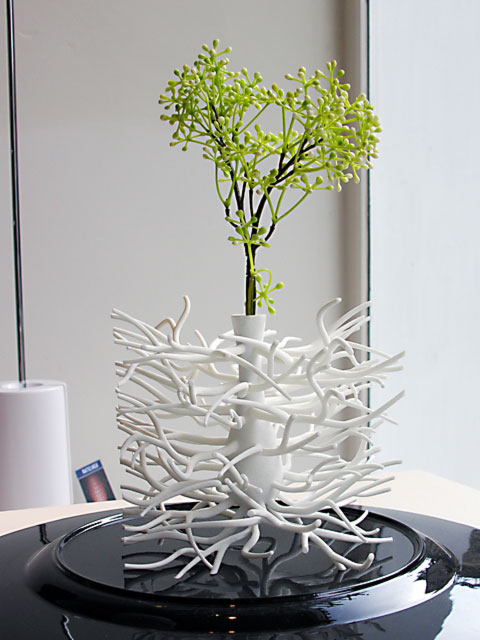
Materialise are specialists in the field of Rapid Prototyping. They offer services to the industrial, medical and dental sectors but with their .MGX brand they have been making major waves in the design world with computer-manufactured designs for lighting and decorative objects. Knowledge of digital tools has allowed the designers to shape and calculate complex mathematical structures. The rapid digital manufacturing techniques of Materialise have enabled these extraordinary shapes to be turned into reality, and have unleashed a new era of rapid manufactured design.

Wednesday, October 11, 2006

PBB Photos

The images aboves are by the following practitioners (top to bottom):

Human Beans

Masaru Tabei & Yasuno Miyauchi

Gavin Baily & Tom Corby

Simon Husslein

Brit Bunkley

Ben Woodeson

NIO Architecten

Tavs Jørgensen

A selection of images of the 'Perimeters, Boundaries and Borders' exhibition is available here.

Or you can also click on the Flashy flickr doodad at the bottom of the sidebar (over there >).

Tuesday, October 03, 2006

Dimensional Imaging Research Laboratories (DIRL)

Ken Rinaldo let me know about the brand new Dimensional Imaging Research Laboratories (DIRL) - a rapid prototyping centre situated in the Department of Art at The Ohio State University. The Laboratory is collaborative effort of the Art & Technology, Ceramics and Sculpture areas in the Department of Art.

http://www.artandtech.osu.edu/dirlweb/index.html

Sunday, October 01, 2006

PBB Symposium


The 'Perimeters, Boundaries and Borders' Symposium at St. Martin's College, Lancaster on Thursday 28 September, 1 – 5pm went really well. The discussion was self-sustaining (to the point that a summary was irrelevant) and raised many important points. The line up was as follows:

13.00 – 13.30 Arrival
13.30 – 13.45 Welcome, Introductions (John Hyatt of Miriad)
13.45 – 14.15 Keynote (Dr. Paul A. Rodgers of Napier University)
14.15 – 14.35 Tavs Jorgensen http://www.oktavius.co.uk/
14.35 – 14.55 Aoife Ludlow http://aoifestuff.com/
14.55 – 15.10 Break
15.10 – 15.35 Justin Marshall http://www.justinmarshall.co.uk/
15.35 – 15.55 Lionel T. Dean http://www.futurefactories.com/
15.55 – 16.15 Human Beans http://www.humanbeans.net/
16.15 – 16.45 Q+A, Discussion
16.45 – 17.00 Summary (John Marshall/Taylor Nuttal)
18.00 – 20.00 Private View @ Citylab, 4-5 Dalton Square, Lancaster LA1 4PP

I recorded the entire session and hope to get it online as a transcript or podcast in the near future.

Tuesday, July 11, 2006

Autonomatic 2 (symposium)

Design Research Symposium
University College Falmouth
15th September 2006.

Symposium on September 15th focuses on the development of creative methods that contribute to 'humanising' the processes of digital production including: digitally capturing human gesture for the development of 3D forms; 'crafting' with 2D and 3D CAD software; and 'drawing' 3D surfaces using computer numerically controlled machinery.

Schedule
9.00 Registration and refreshments in the Stannary
9.30 Welcome John Miller, Director of Design, UCF, Media Centre Cinema
9.40 Hello, we are Autonomatic Dr Katie Bunnell Autonomatic Research Cluster Leader
10.00 Fluidforms Hannes Walter and Stephen Williams
11.00 Refreshments
11.30 Motion in Form Tavs Jorgensen, Autonomatic Research Fellow, UCF
11.50 Risk Drummond Masterton, Autonomatic Research Assistant, UCF
12.10 Questions from the floor
12.30 Lunch and Exhibition viewing
2.00 Geoff Mann, Product-Artist http://www.mrmann.co.uk/
2.20 Coded Ornament Justin Marshall, Autonomatic Research Fellow,
2.50 Post-Industrial Manufacturing Paul Atkinson, University of Huddersfield
3.20 Industreal Costanza Calvetti
4.15 Questions from the floor and round up
4.30 Drinks in the Auto-Exhibition, Design Centre
5.00 Close

Download a registration form here

Symposium cost: £90 Workshop and Symposium cost: £250

Blog Archive

My Portfolio

John Marshall Portfolio

My Linkedin Profile

View John Marshall's profile on LinkedIn

rootoftwo's shared items

About

I am exploring a hybrid form of art and design practice through the use of computer-based design and fabrication tools. I am interested in experimental objects and spaces that are dynamic and responsive and seek to challenge perceptions, expectations and established behavior.

Creative Commons

My del.icio.us

Site Meter